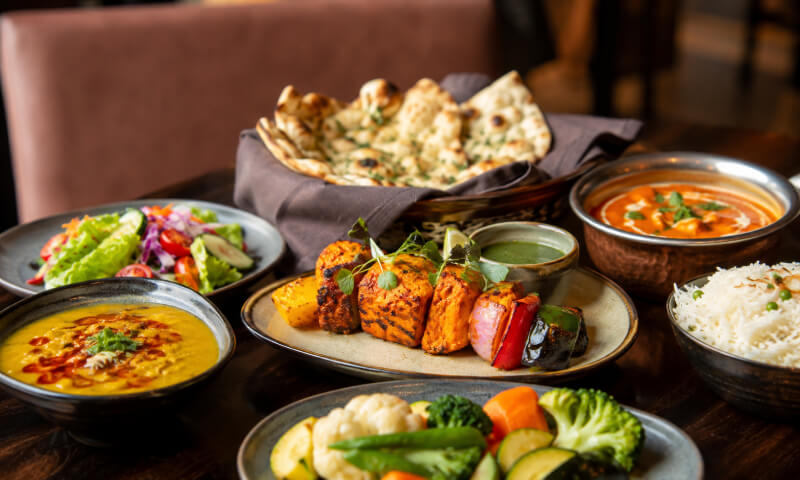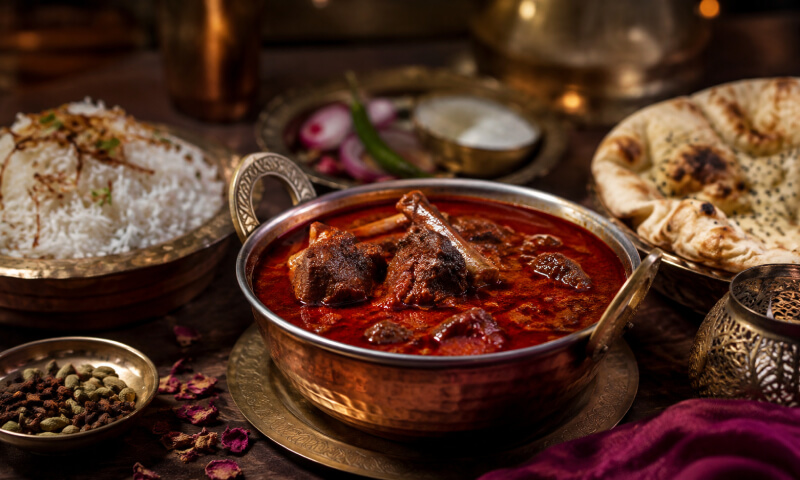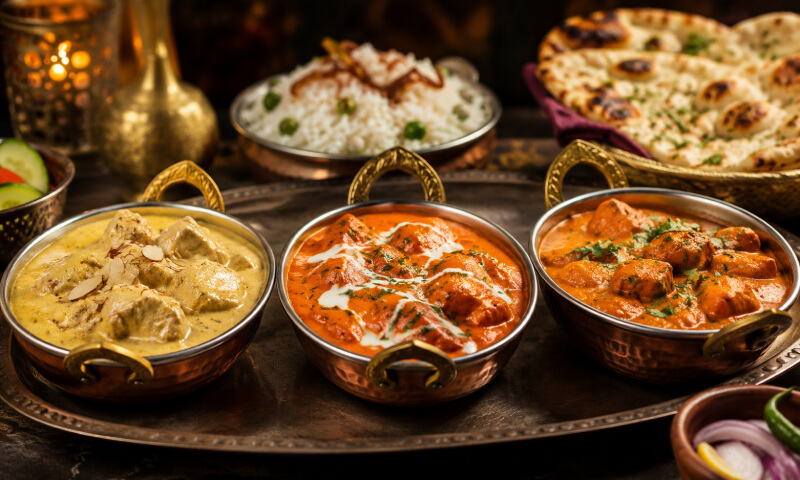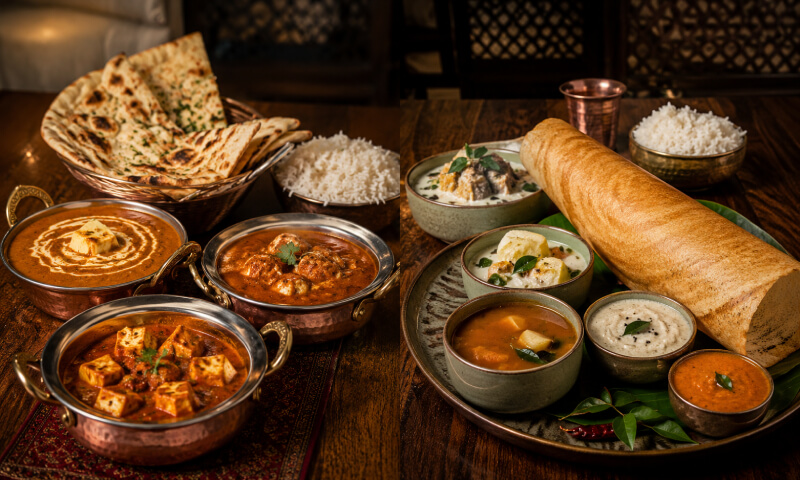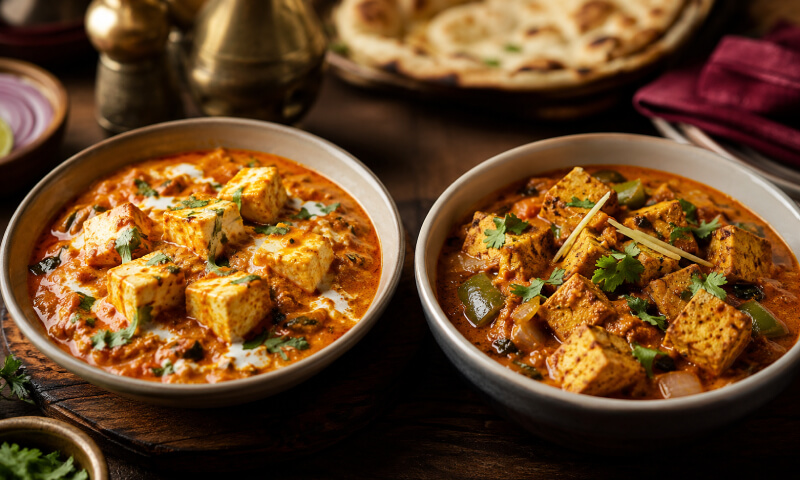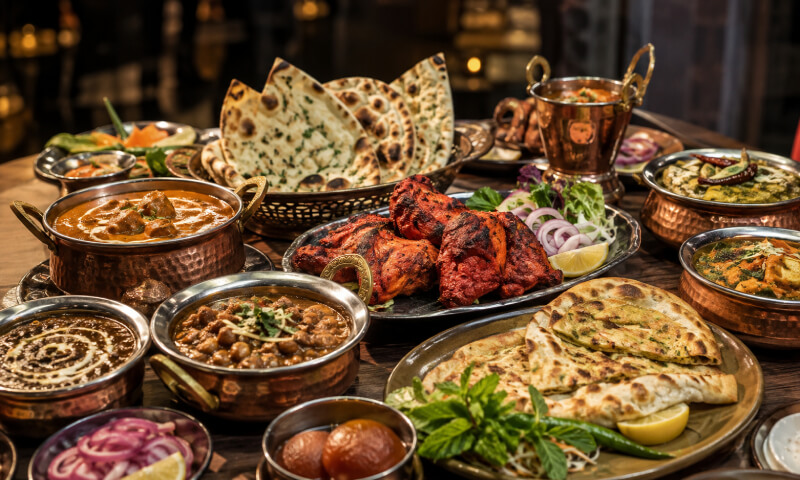
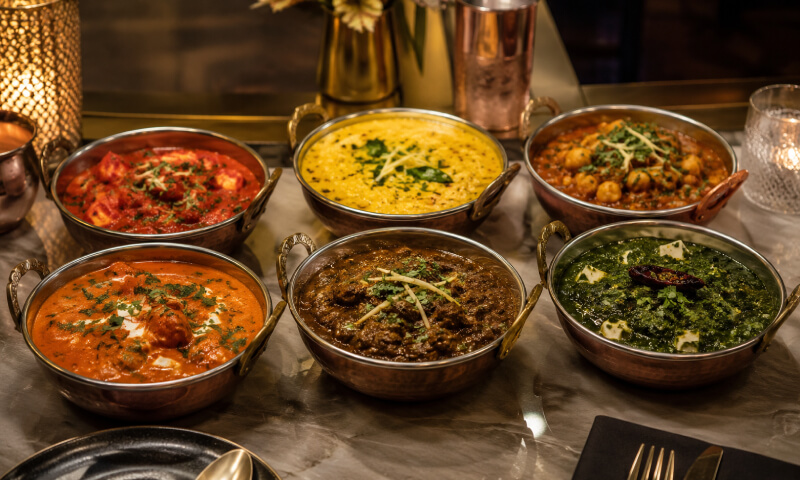
Indian curries sort into six families based on what the gravy is built from: cream and nut, tomato and onion, yoghurt, coconut, lentil, and dry or semi-dry. Korma is a nut gravy. Rogan josh is tomato and onion. Tikka masala is yoghurt and cream. Madras is coconut. Dal makhani is lentils. Karahi is barely a gravy at all. Learn the six and you can order anywhere.
Why an alphabetical list of curries is useless
Most “types of Indian curry” articles list twenty dishes in no particular order with a sentence each. You read it, you nod, and you order butter chicken anyway, because nothing in the list told you how any of it relates to anything else.
Here’s the thing that makes ordering easy. An Indian curry is a protein or a vegetable sitting in a gravy, and the gravy is where all the character lives. Learn what gravies exist and every dish name suddenly makes sense, including ones you’ve never seen before.
Jasvinder has been cooking these on Margaret Street since 2014. He’s from Rajasthan, where the food is dry, hot and quite unlike the creamy stuff most Australians think of as Indian. Below is how a working kitchen actually thinks about the categories.
1. Cream and nut based
The gravy: cashew or almond paste, cream, butter, sometimes a little tomato. No sourness to speak of.
This is the family that made Indian food popular in Australia, and it’s the mildest of the six. Nuts and dairy do two things at once. They thicken the gravy without flour, and they blunt chilli, which is why the whole family sits at the gentle end.
On our menu: Vegetable Korma and Beef Korma (pure cashew and cream, no tomato at all), Butter Chicken, Paneer Butter Masala, Fish Butter Masala, Butter Prawns, Malai Kofta, Shahi Paneer, Mango Chicken.
Korma is the purest version because it has no tomato, so there’s no tang, just nut and warm whole spice. Butter chicken adds cooked-down tomato, which is why it tastes sweeter and slightly sharper. Malai Kofta is the richest thing in this family and probably on the whole menu. Malai means cream, and it isn’t shy about it.
Our honest opinion: this family is very good and Australia over-orders it. A table where every dish is cream based tastes like one dish by the end. More on the mild end in our guide to mild Indian curries.
2. Tomato and onion based
The gravy: onions cooked down slowly until sweet and dark, ginger, garlic, tomato, ground spice. Little or no dairy.
This is the workhorse family, and honestly it’s where the best cooking usually is. Nothing hides here. If the onions weren’t cooked properly you can taste it immediately, because there’s no cream to cover the gap.
On our menu: Lamb Rogan Josh, Vegetable Jalfrezi, Channa Masala, Desi Chicken, Bombay Beef, Chicken Vindaloo, Lamb Vindaloo.
Rogan josh deserves a note. In Kashmir, where it comes from, the traditional gravy uses yoghurt and Kashmiri chilli and often no tomato at all. What’s served across Australia is a tomato and onion version. Both are legitimate, they’re just different dishes wearing the same name, and anyone who tells you there’s one correct rogan josh is overstating it.
Jalfrezi is the family’s underrated member. Capsicum, onion and tomato, cooked hot and fast so the vegetables keep some bite. It’s the dish we put on a table that’s ordered too much cream.
Vindaloo technically sits here too, but its defining ingredient is vinegar rather than tomato. More on that in our heat level ranking.
3. Yoghurt based
The gravy: yoghurt, either from the marinade or stirred into the sauce, usually over an onion base.
Yoghurt does something no other thickener does. It brings a gentle sourness and it tenderises meat before it ever hits the pan. Handle it badly and it splits, which is the main reason weaker kitchens avoid it.
On our menu: Chicken Tikka Masala, Laal Maas.
Tikka masala starts with chicken marinated in yoghurt and cooked in the tandoor, then finished in an onion and tomato gravy with cream. The yoghurt tang is the thing that separates it from butter chicken, and it’s why we think it’s the better dish. We’ve argued that out in butter chicken vs tikka masala.
Laal Maas is Jasvinder’s home dish. Rajasthani lamb, cooked with a lot of dried red chilli and yoghurt, and no tomato. The yoghurt is not there to cool it down. It’s there to carry the chilli. This is the hottest thing we serve and we don’t apologise for it.
4. Coconut based
The gravy: coconut milk or ground coconut, tamarind or vinegar for sourness, curry leaves, mustard seed.
Southern and coastal cooking. The texture is thinner than a northern gravy, more like a sauce than a paste, and the flavour is sour and hot at the same time rather than rich.
On our menu: Goan Fish Curry, Prawn Madras, Goat Madras, Beef Madras.
Coconut confuses people, because they assume it means mild. It doesn’t. Madras is properly hot and the coconut is there for body against the chilli, not instead of it.
Goan Fish Curry is the one we’d point a curious eater towards. Sour, hot, light, and unlike anything in the first two families. If you’ve only eaten north Indian food in Australia, this is the fastest way to realise how narrow that experience has been.
5. Lentil based
The gravy: the lentils are the gravy. No separate sauce.
Dal is the food Indian families actually eat most nights, and it’s the category Australians skip most often. That’s a mistake, and we’ll die on this hill.
On our menu: Yellow Dal Tadka, Dal Makhani, Lamb Dhansak.
Yellow Dal Tadka is split lentils cooked soft, then finished with a tadka, which is whole spices bloomed in hot fat and poured over at the last second. It’s the cheapest dish in the section and the one that gets scraped clean.
Dal Makhani is the rich one. Black lentils and kidney beans cooked long and slow with butter and cream. It’s dal in the way that a slow-braised beef cheek is beef. Not vegan, despite being vegetarian.
Dhansak is a Parsi dish, lentils and lamb cooked together with a sweet and sour edge. It’s the only curry on most menus that’s genuinely sweet and hot at once.
6. Dry and semi-dry
The gravy: barely any. The spice clings to the food instead of sitting under it.
These are cooked hard and fast in a karahi, which is a heavy steel wok, or simmered until the liquid has gone. Rajasthan and Punjab both cook this way constantly, and it’s the family most people never order because there’s no sauce for the naan.
On our menu: Karahi Chicken, Karahi Paneer, Aloo Gobi, Lamb Saagwala, Aloo Palak, Aloo Baingan, Chilli Paneer Dry, Chilli Chicken Dry.
Karahi is the one to try. Tomato, capsicum, ginger and a lot of black pepper, reduced until it coats. Saagwala is spinach cooked down to a thick green base, which technically makes it a gravy, but it eats like a dry dish.
Order one of these alongside a wet curry and the whole table improves. Two wet curries next to each other blur. A wet one and a dry one don’t.
The base gravy problem
Now the part most restaurant blogs won’t tell you.
A lot of kitchens make one large pot of base gravy in the morning, usually onion, tomato, garlic and oil blended smooth. Every order gets a ladle of that base, plus a spoon of whatever powder corresponds to the dish name, plus cream if it’s meant to be creamy. Twelve minutes, done.
It’s efficient. It’s also why so many curries taste like variations on the same thing. When korma, rogan josh and madras all start from the same pot, the six families collapse into one, and the only differences left are how much cream and how much chilli went in at the end.
You can taste it. Base-gravy cooking has a flat, slightly sweet sameness under every dish, and the individual spices never separate out. A properly built curry has layers you can pick apart, because the onions for a rogan josh were cooked differently from the onions for a jalfrezi, and the korma never met an onion at all.
We cook to order. It’s slower on a Friday night and we’ve made our peace with that.
Quick reference
| Family | Base | Heat range | Menu examples |
|---|---|---|---|
| Cream and nut | Cashew, cream, butter | Very low | Korma, Butter Chicken, Malai Kofta |
| Tomato and onion | Onion, tomato, spice | Low to very high | Rogan Josh, Jalfrezi, Vindaloo |
| Yoghurt | Yoghurt, onion | Medium to very high | Tikka Masala, Laal Maas |
| Coconut | Coconut, tamarind | Medium to high | Goan Fish Curry, Madras |
| Lentil | Lentils | Low to medium | Yellow Dal Tadka, Dal Makhani, Dhansak |
| Dry / semi-dry | Little or none | Medium to high | Karahi, Aloo Gobi, Saagwala |
How to use this when you order
Pick from different families, not different proteins. A table that orders butter chicken, korma and paneer butter masala has ordered the same dish three times with different things floating in it. Two dishes for two people should be one wet and one dry. Four dishes should touch at least three families and include a dal. There’s a full formula in our first-timer’s guide, and the heat side of it is in the heat ranking.
A Toowoomba note
The range gets genuinely cold in July, and you can watch the order mix change with it. Dal makhani, korma and butter chicken climb through winter. Come November the same regulars are ordering jalfrezi and karahi, because nobody wants a bowl of cream when it’s 33 degrees.
The other pattern is Carnival of Flowers in September, when visiting tables order almost entirely from the cream family. Fair enough, it’s safe common ground. But a table of eight is the best chance you’ll get to order across four families and find out what you actually like.
Frequently asked questions
How many types of Indian curry are there?
There’s no fixed number, because “curry” is a British umbrella term rather than an Indian one. India has hundreds of regional gravies. For ordering purposes, six families cover almost everything on an Australian menu: cream and nut, tomato and onion, yoghurt, coconut, lentil, and dry or semi-dry.
What’s the difference between korma, rogan josh and madras?
They’re from three different families. Korma is cashew paste and cream, mild and slightly sweet. Rogan josh is a slow-cooked onion and tomato gravy with warm spice, medium heat. Madras is coconut and tamarind, sour and properly hot. The protein matters far less than the gravy.
Which type of Indian curry is the mildest?
Cream and nut based, and korma specifically. It contains no tomato, so it has neither chilli heat nor acidity. Butter chicken and paneer butter masala sit just above it. If you want detail on the whole mild end, read our mild curry guide.
Is curry an Indian word?
Not really. It’s an anglicisation, most likely of the Tamil word kari, adopted by the British to cover an enormous range of unrelated dishes. In India you’d name the actual dish. Nobody in Rajasthan asks for curry, they ask for laal maas or gatte ki sabzi.
What is a dry curry?
One cooked until almost no liquid remains, so the spice coats the food rather than pooling under it. Karahi dishes, aloo gobi and chilli paneer are examples. They’re eaten with bread or rice the same way, and they add contrast to a table that’s otherwise all sauce.
Which curry has coconut in it?
On our menu, Goan Fish Curry, Prawn Madras, Goat Madras and Beef Madras. Coconut is standard in southern and coastal Indian cooking and rare in northern cooking. It doesn’t make a dish mild, and madras in particular is hot.
Are Indian curries gluten free?
Most of our curries are, and they’re marked (GF) on the menu. The gravies are thickened with nuts, onions, lentils or reduction rather than flour. Breads are the problem, since every naan and roti contains wheat. Details on our gluten free Indian food page.
Do all these curries come mild, medium or hot?
The mild, medium and hot choice adjusts chilli, and we’ll cook most dishes to whichever you pick. But some dishes are defined by their heat. A mild vindaloo or a mild laal maas isn’t really that dish any more, and we’ll usually suggest something else instead.
Six families, and most people have only ever eaten from one of them. Next time you’re in, order a korma and a Goan Fish Curry side by side and taste how far apart Indian food actually spreads. Both are on the full menu, and the staff will happily tell you which family anything else belongs to.