Indian breads split three ways: by leavening, by flour, and by how they’re cooked. Naan and kulcha are leavened white-flour breads baked in a tandoor. Roti, chapati and paratha are unleavened wholemeal atta breads cooked on a flat griddle called a tawa. Puri is unleavened and deep fried. Dosa isn’t really bread at all, it’s a fermented rice and lentil crepe from South India.
Leavened or unleavened is the first fork in the road
Leavened bread has something in it making it rise. In Indian breads that’s usually yoghurt, sometimes yeast, sometimes baking powder. Naan is the obvious example, and it comes out puffed and chewy with a soft crumb.
Unleavened bread has none of that. Roti is flour, water and salt, rolled thin and cooked. It puffs on the griddle from steam alone, then deflates. What you get is thin, pliable and much lighter to eat.
That changes what the bread is for. Naan is rich enough to be part of the meal in its own right. Roti is a tool for getting curry into your mouth, which sounds dismissive but is genuinely how it’s used at most tables in northern India, including in Rajasthan where our chef Jasvinder grew up.
Flour matters more than most menus admit
Naan is made with maida, a finely milled refined white wheat flour, closer to what Australians would call plain flour. It stretches, it browns well, and it makes a bread that’s soft and slightly chewy.
Roti and chapati use atta, a wholemeal flour milled from the whole grain. It’s darker, nuttier and more absorbent, so the bread is denser per bite but thinner overall, tasting more of wheat and less of dairy and fat.
If you’ve wondered why naan feels like a treat and roti feels like everyday food, the flour is most of the answer. In a lot of Indian households roti is on the table every night, because most homes don’t have a tandoor.
Tandoor, tawa or deep fryer
This is the third split, and it changes the texture more than the ingredients do.
Tandoor breads are slapped onto the inside wall of a clay oven running well above 400C. They cook in about 90 seconds, blister in patches, and pick up smoke from the charcoal below. Naan and kulcha are tandoor breads, and our Butter Roti is cooked there too, which is standard in Australian Indian restaurants because the tandoor is already running. We’ve written a full piece on what a tandoor is if you want the mechanics.
Tawa is a flat iron griddle. Chapati, plain roti and paratha are cooked on it, dry for chapati and with ghee for paratha. Tawa bread has an even surface with light brown spots rather than the black blistering you get from clay.
Deep fried is puri. The dough goes into hot oil and inflates like a balloon in seconds. It comes out golden, hollow and rich.
The six breads, quickly
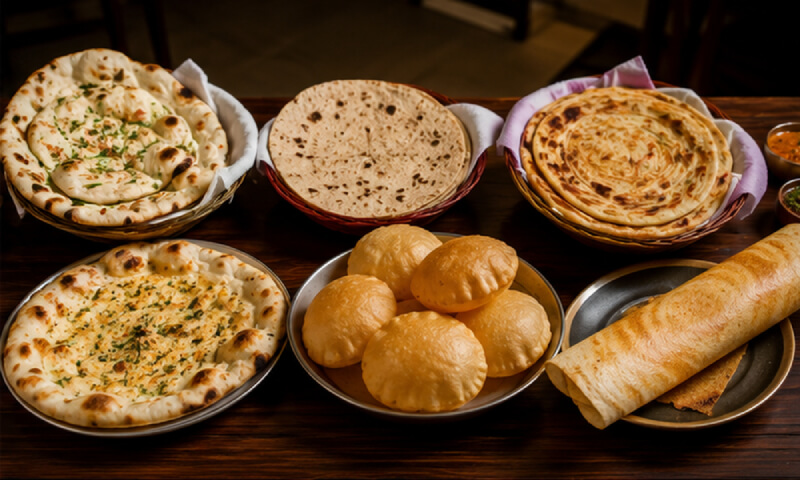
Naan. Leavened, white flour, tandoor baked, usually brushed with butter or ghee. Soft, chewy, teardrop shaped because it stretches under its own weight on the oven wall. The most familiar Indian bread in Australia by a long way.
Roti and chapati. Broadly the same thing, and people argue about the distinction. Unleavened atta bread, thin, cooked on a tawa. Chapati is generally the plainer home version. Roti is the term you’ll see on restaurant menus. Neither has the fat content of naan.
Paratha. Unleavened atta dough that’s been layered with ghee and folded repeatedly before cooking, which gives it flaky layers. It’s richer than roti and often stuffed, with potato (aloo paratha) being the classic. Cooked on a tawa, not in a tandoor. Breakfast food in a lot of North India.
Kulcha. A close cousin of naan: leavened white-flour bread, tandoor baked. The differences are subtle. Kulcha is typically made with baking powder rather than yeast, comes out denser and flatter, and is associated with Amritsar in Punjab, usually stuffed with spiced potato or onion.
Puri. Small, unleavened, deep fried, puffs into a hollow sphere. Eaten with chana or potato curry, often at breakfast or on festival days. It has to be eaten hot because it collapses and turns oily as it cools.
Dosa. The odd one out. It’s from South India, it contains no wheat, and it isn’t baked or fried in the sense the others are. Rice and urad dal are soaked, ground and fermented overnight, then the batter is spread thin on a hot griddle into a large crisp crepe. Masala dosa is the version filled with spiced potato. Calling it a bread is a stretch, but it turns up on every list of Indian breads so it’s worth knowing what it is.
What we actually serve, and what we don’t
We’d rather be straight about this than let a list imply the whole menu.
At Ice n Spice we serve Butter Roti and a naan range: Plain Butter Naan, Garlic Naan, Cheese Naan, Paneer Naan, Aloo Stuffed Naan and Chicken Tikka Naan, from 5to8.50. There’s a separate post breaking down the types of naan and which curry each one suits.
We do not serve paratha, kulcha, puri or dosa. Dosa in particular needs an overnight ferment and a dedicated griddle, which is a different kitchen to the one we run. Our food is northern, mostly Punjabi and Rajasthani, and the bread list reflects that.
The Lunch Thali, served 11:30am to 2pm, includes rice and bread with two dishes, which is the cheapest way to try it.
If you can’t eat wheat
Every bread on our menu contains wheat. Naan, roti, all of it. There’s no gluten free bread option, and we won’t pretend there is.
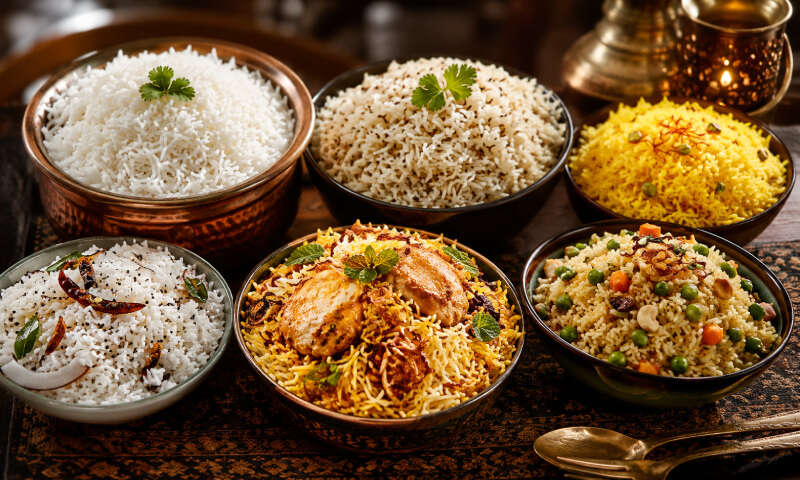
What we do have is a large gluten free section across the curries, marked (GF) on the menu, and rice that’s naturally gluten free. Steamed basmati, jeera, saffron and coconut rice all work as a bread substitute, and most of our curries are better with rice anyway. The detail is on our gluten free Indian food page, and there’s a separate rundown of the Indian rice dishes on the menu.
Honest labelling is worth more here than a workaround. Telling a coeliac customer that a wheat-flour bread is fine because it’s “only a little” is how people end up sick.
Which bread with which curry
A few opinions, because a list of breads with no guidance is not much use.
Butter Roti with anything rich. If you’re eating Butter Chicken, Dal Makhani or Malai Kofta, roti beats naan, because naan plus a cream sauce is fat on fat and you’ll be full halfway through.
Garlic Naan with drier or tomato-based dishes. Karahi Chicken, Vegetable Jalfrezi, Channa Masala. It has enough character to hold its own without competing.
Plain Butter Naan with the hot end of the menu. Vindaloo, Laal Maas, Prawn Madras. Plain bread is what you want when the curry does all the work, and the dairy takes the edge off the chilli.
Cheese Naan with nothing, really. It’s a lovely thing, but it’s a snack rather than a partner to a curry and it bulldozes whatever it’s eaten with. Order it if you want it. Just don’t expect it to sit politely next to a Rogan Josh.
Frequently asked questions
What is the difference between naan and roti?
Naan is leavened, made with refined white flour, baked in a tandoor and usually brushed with butter, so it’s soft, chewy and rich. Roti is unleavened, made with wholemeal atta flour, and traditionally cooked on a flat griddle, so it’s thinner and lighter. Naan is restaurant and occasion food. Roti is what most North Indian households eat daily.
Is roti healthier than naan?
Generally yes. Roti uses wholemeal flour, has no leavening, and carries far less fat, since naan is typically brushed with butter or ghee and is made from refined flour. If you’re eating a rich curry, roti is the sensible partner. Neither is gluten free, so neither works for coeliac diners.
What is the difference between roti and chapati?
Very little, and people disagree about where the line sits. Both are unleavened wholemeal flatbreads cooked on a griddle. Chapati usually refers to the thin, plain, everyday home version. Roti is the broader term and the one used on restaurant menus, sometimes for a slightly thicker bread or one cooked in the tandoor.
Is naan bread vegan?
Ours is not. Naan dough typically contains yoghurt or milk, and it’s finished with butter, so it’s vegetarian rather than vegan. That applies to the whole naan range at Ice n Spice. Vegan diners are better off with rice, which is naturally vegan, alongside dishes like channa masala, aloo gobi or vegetable jalfrezi.
What is paratha?
An unleavened wholemeal bread that’s layered with ghee and folded before rolling, which creates flaky layers when it cooks on a griddle. It’s richer than roti and often stuffed, most commonly with spiced potato. It’s a North Indian breakfast staple. We don’t serve paratha at Ice n Spice.
Is dosa an Indian bread?
Not really, though it appears on most bread lists. Dosa is a large thin crepe from South India made from fermented rice and lentil batter, cooked on a griddle. It contains no wheat. The fermentation takes overnight, which is why it’s usually made in kitchens that specialise in South Indian food.
Which Indian breads are gluten free?
Very few of the common ones. Naan, roti, chapati, paratha, kulcha and puri are all wheat based. Dosa and appam are made from rice and lentils so they’re naturally gluten free, but they’re South Indian and not on our menu. At Ice n Spice, rice is the reliable gluten free option and there’s a large (GF) marked section of curries.
Which Indian breads does Ice n Spice serve?
Butter Roti plus six naans: Plain Butter, Garlic, Cheese, Paneer, Aloo Stuffed and Chicken Tikka, priced 5to8.50. All are baked in our clay tandoor and all contain wheat. We don’t serve paratha, kulcha, puri or dosa.
Why is naan shaped like a teardrop?
Because of how it’s cooked. The dough is stretched over the hand and slapped onto the vertical wall of the tandoor, then gravity pulls the lower end down while it bakes. The shape is a by-product of the oven, not a decision. A naan cooked flat in a pan comes out round.
If you’re deciding at the table, the honest recommendation is one Butter Roti and one Garlic Naan between two people, then rice for anything saucy. That covers the range without leaving half a bread going cold. Our full menu is online and we’re open for lunch and dinner seven days on Margaret Street.