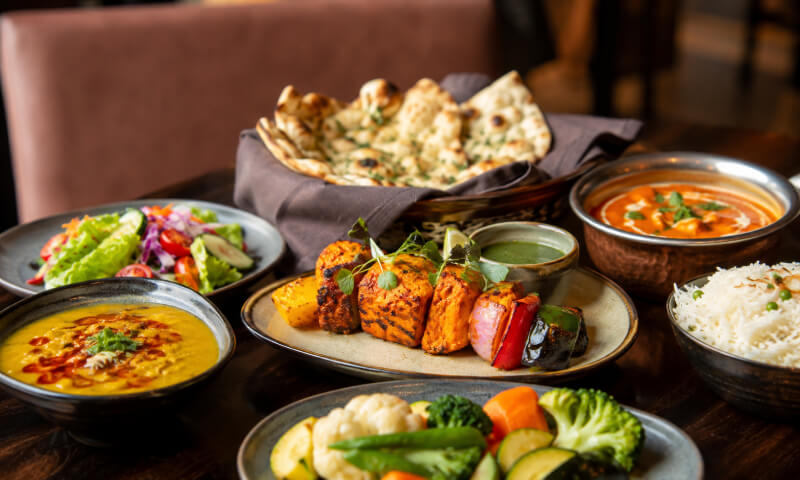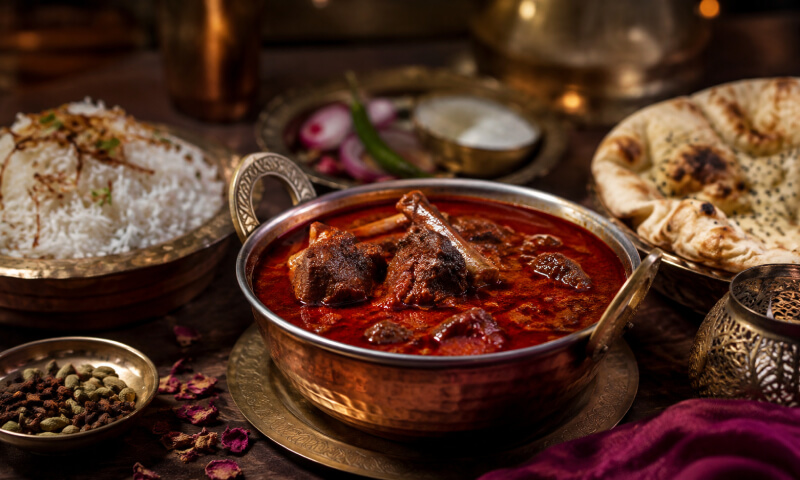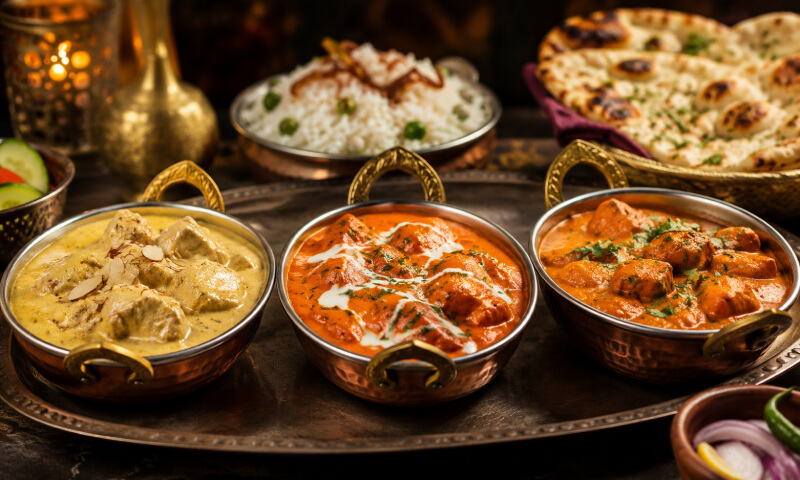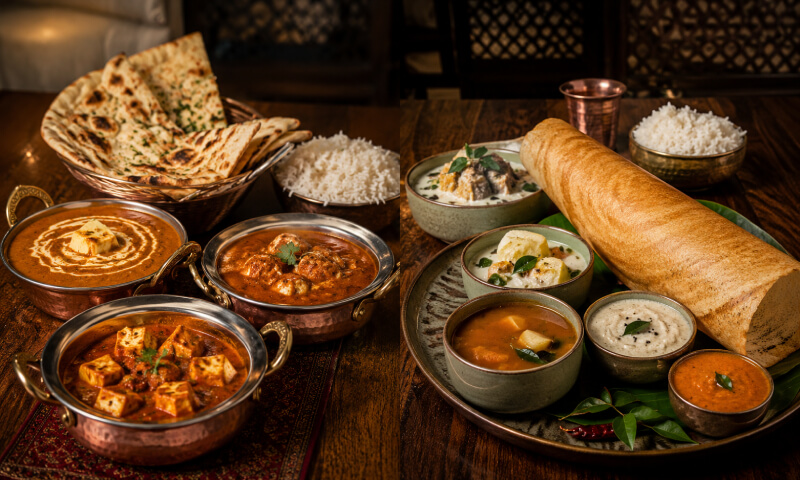
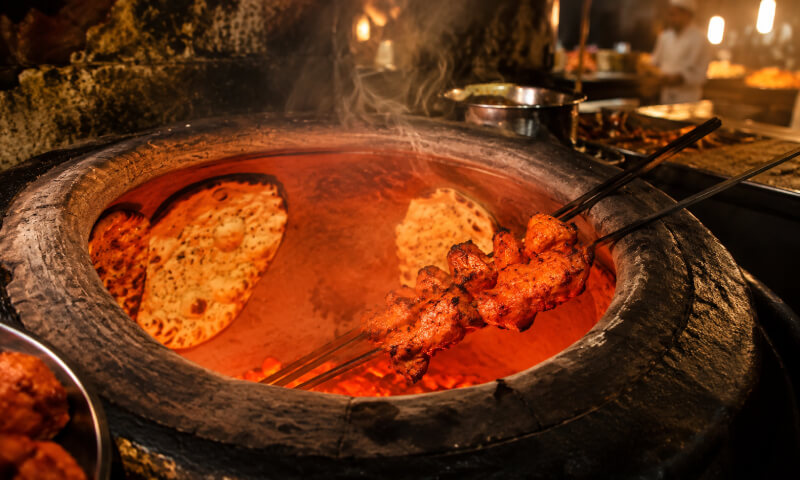
A tandoor is a deep, bell-shaped clay oven fired by charcoal at the base, running well above 400C. Food cooks in minutes from three directions at once: radiant heat off the clay walls, hot air rising through the chamber, and smoke from fat dripping onto the coals. That combination is what gives tandoori meat its char and smoke while the inside stays juicy.
What a tandoor actually is
Strip away the mystique and a tandoor is a clay pot the size of a wheelie bin, sunk into an insulated steel casing. The clay is thick, often 5 to 8 centimetres, and it holds heat the way a brick holds heat. Charcoal sits in a bed at the bottom. The mouth at the top is narrow, which traps heat inside instead of letting it pour out.
We light ours before lunch service and it stays hot through to close. It doesn’t get switched on and off like a domestic oven. That’s the first thing people don’t realise about tandoor cooking: the oven is never cold, and the clay itself is the heat source as much as the coals are.
The shape matters too. Curved walls bounce heat back towards the centre from every angle, so a skewer hanging in the middle of the chamber cooks evenly on all sides. Nothing needs turning.
The temperature is the whole point
A good domestic oven in Toowoomba tops out around 250C. A tandoor at working heat sits somewhere well above 400C, and near the coals it’s hotter again. That’s not a small difference. It’s a different category of cooking.
At 250C, a chicken thigh takes 25 to 30 minutes. By the time the surface browns, the inside has been sitting in the heat long enough to lose a lot of its moisture. At tandoor temperatures the same piece of chicken is done in a few minutes. The outside chars before the middle has time to dry out.
That’s the trick, and it’s a physics trick rather than a recipe one. Char and dryness usually travel together. Extreme heat separates them.
Three kinds of heat at once
Radiant heat. The clay walls glow and throw heat directly at the food, the same way a fire warms your face across a room. This is what browns the surface fast.
Convection. Hot air rises up through the narrow chamber and past the skewers. This is closer to what a fan-forced oven does, just far hotter.
Smoke. Fat and marinade drip off the meat onto the coals below, flare, and rise back up as smoke. This is the flavour most people are actually chasing when they order tandoori. It’s not a spice. It’s the food seasoning itself on the way down and being seasoned again on the way back up.
You can replicate one of those three at home. Getting all three at once is the part that doesn’t work in a suburban kitchen.
What comes out of our tandoor
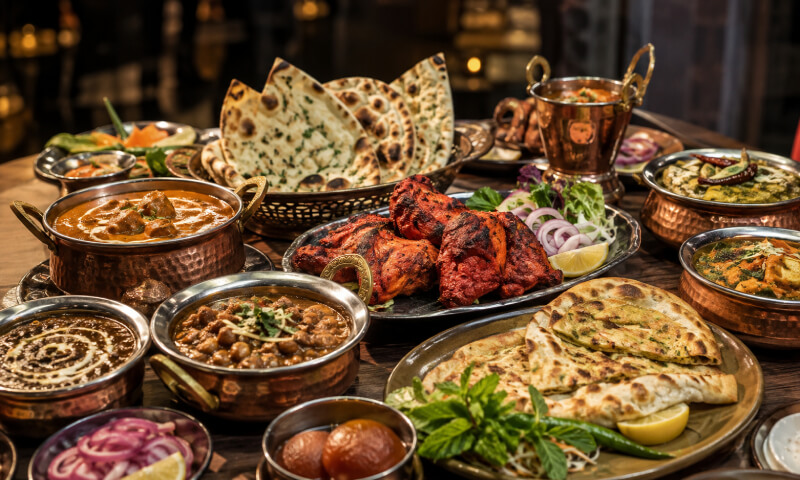
Every bread on our menu is a tandoor bread. The dough gets slapped onto the inside wall of the clay by hand, sticks there, puffs, blisters and comes off with a hooked rod maybe 90 seconds later. That includes the whole naan range, from Plain Butter Naan through to Aloo Stuffed Naan and Chicken Tikka Naan, and the Butter Roti as well. If you want the detail on which is which, we’ve written a full guide to the types of naan on the menu.
On the meat side, the Royal Entrees are all tandoor: Lamb Cutlets, Lamb Seekh Kebab and Chicken Tikka. The cutlets are the one to order if you’ve never eaten properly from a tandoor. Lamb on the bone, marinated, cooked hard and fast, with the fat catching and smoking underneath. The Seekh Kebab is minced lamb pressed onto a skewer, which is a harder thing to get right than it looks, because loose mince falls into the coals and dry mince tastes like a sausage that gave up.
Chicken Tikka does double duty. It’s an entree in its own right, and it’s the filling in the Chicken Tikka Naan.
The red food colouring problem
Somewhere along the way, tandoori chicken in the West became a dish defined by being bright red. It shouldn’t be. That colour comes from food dye, usually a lot of it, added because a photogenic red sells better than the actual colour of the dish.
Real tandoori marinade is yoghurt, ginger, garlic, lemon, salt and spice, with Kashmiri chilli for warmth and a deep rusty red that’s nothing like the colour of a traffic cone. Cooked properly the meat comes out somewhere between brick and brown, with black blistering where it met the heat hardest. If it’s uniformly fluorescent, that’s dye, and dye tastes of nothing.
Jasvinder is from Rajasthan, where the tandoor is standard kit rather than a novelty, and this is a thing he’s fairly blunt about. Colour is not flavour. If a marinade needs dye to look appetising, it wasn’t strong enough to begin with.
Why it never quite works at home
People ask us about home tandoors fairly often, and you can buy real ones. They work, in the sense that they’re genuine clay ovens. Two things get in the way.
Heat retention is the first. A small tandoor cools much faster than a commercial one, because there’s less clay holding the temperature and more surface area losing it. Cook two batches and the second is cooking in a different oven to the first. It’s also a full-time appliance. Firing charcoal, waiting for it to settle, then cooking one dinner and letting it go cold is a lot of effort for one meal.
The second is technique. Slapping wet dough onto a vertical clay wall at over 400C without losing it into the coals, or losing skin off your forearm, takes practice that only comes from doing it hundreds of times a week.
A grill or a very hot barbecue with the lid down will get you a decent marinated chicken. It’s a good dish. It just isn’t the same dish.
Frequently asked questions
What temperature does a tandoor reach?
Working temperature is well above 400C, and the area closest to the charcoal bed runs hotter still. For comparison, most domestic ovens stop around 250C. That gap is why tandoori food can’t really be replicated at home. Meat cooks in a few minutes at tandoor heat, so it chars on the outside before the inside has time to dry out.
Is a tandoor gas or charcoal?
Both exist. Gas tandoors are common in commercial kitchens because they’re easier to control and cleaner to run. Charcoal is the traditional fuel and it does something gas can’t, because the smoke that flavours the food comes from fat dripping onto burning coals. We run a clay tandoor with charcoal at Ice n Spice.
Why is tandoori chicken red?
In most restaurants, food colouring. Traditional marinade uses yoghurt, lemon, ginger, garlic and Kashmiri chilli, which gives a deep rusty red rather than a bright one. Anything approaching fluorescent has dye in it. Dye adds no flavour at all, so it’s a purely cosmetic decision.
Does the tandoor make the food spicy?
No. The tandoor adds smoke and char, not chilli heat. Spice level comes from the marinade and from whatever sauce the dish is served with. Our tandoor entrees are moderate rather than hot, and we cook to mild, medium or hot across the menu, so heat level is your call.
Is tandoori food healthy?
It’s cooked without added oil, and the fat renders out of the meat and drips into the coals rather than sitting in a sauce, so it’s one of the lighter ways to eat Indian food. The marinade is yoghurt based. If you’re watching what you eat, tandoor entrees with rice are a lighter option than a cream-based curry with naan.
Which dishes at Ice n Spice come out of the tandoor?
The Royal Entrees, which are Lamb Cutlets, Lamb Seekh Kebab and Chicken Tikka. Plus every bread on the menu, since naan and roti are baked against the clay wall rather than on a griddle. Curries are cooked on the stove, though tandoor-cooked chicken goes into some of them.
Can I buy a tandoor for home use?
Yes, home tandoors are sold in Australia and they’re real clay ovens. The practical problems are that a small one loses heat fast between batches, and firing charcoal for a single dinner is a lot of work. A very hot covered barbecue gets you most of the way there with a fraction of the effort.
What’s the difference between tandoori and tikka?
Tandoori usually refers to larger pieces or bone-in cuts cooked in the tandoor, while tikka means boneless pieces on a skewer. Both use similar yoghurt-based marinades and both cook in the same oven. Tikka pieces cook faster because they’re smaller, so they get proportionally more char per bite.
Why does tandoori food taste smoky if there’s no smoke flavouring?
Because there’s real smoke. Fat and marinade drip off the skewers onto the charcoal, flare up, and the smoke rises back through the chamber past the food. The meat is smoked by its own drippings while it cooks. That’s a self-contained process no domestic oven can copy.
If you want to taste what we’re describing rather than read about it, order the Lamb Cutlets as an entree and a Plain Butter Naan alongside them. Both come out of the same oven within a couple of minutes of each other, and the difference between that naan and a supermarket one is the whole argument for a tandoor in one bite. We’re on Margaret Street, open for lunch and dinner seven days.