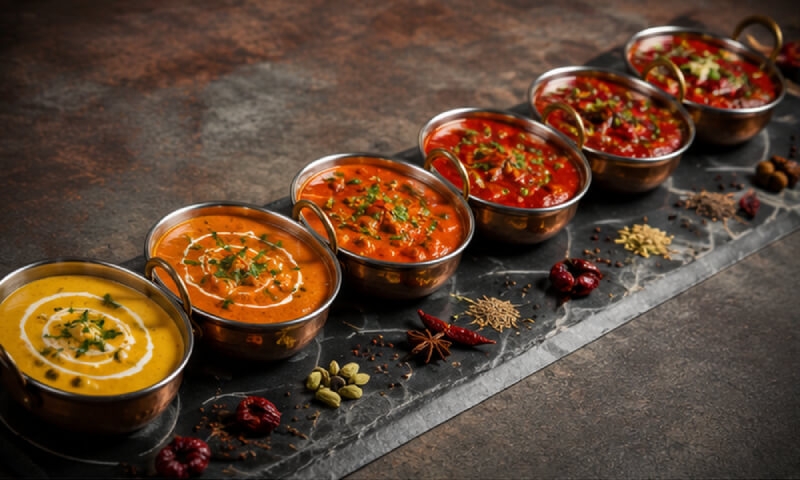
Ranked from mildest to hottest, the standard Indian curries run: korma, mango chicken, butter chicken, paneer butter masala, malai kofta, tikka masala, dal makhani, saagwala, karahi, rogan josh, jalfrezi, dhansak, madras, vindaloo, and laal maas at the top. Korma has almost no chilli. Laal maas is built on it.
The ranking
Here’s the whole menu on one scale. We’ve used a one to ten rating, where one is a dish with no chilli in it and ten is as hot as we’re prepared to serve food.
| Heat | Dish | What drives it |
|---|---|---|
| 1 | Vegetable Korma, Beef Korma | Cashew and cream, no chilli |
| 1 | Mango Chicken | Mango pulp and cream |
| 2 | Butter Chicken | Kashmiri chilli for colour, not heat |
| 2 | Paneer Butter Masala, Fish Butter Masala, Butter Prawns | Same makhani gravy |
| 2 | Malai Kofta, Shahi Paneer | Cream forward |
| 2 | Aloo Gobi, Aloo Baingan | Gentle as we cook them |
| 3 | Yellow Dal Tadka | Warmth from the tadka, not chilli |
| 3 | Dal Makhani | Butter and cream flatten it |
| 4 | Chicken Tikka Masala | Garam masala and a little chilli |
| 4 | Lamb Saagwala, Aloo Palak | Spinach softens everything |
| 4 | Channa Masala | Depends on how you order it |
| 5 | Lamb Rogan Josh | Kashmiri chilli, aromatic rather than sharp |
| 5 | Desi Chicken, Bombay Beef | Home-style, medium by default |
| 6 | Karahi Chicken, Karahi Paneer | Black pepper and green chilli |
| 6 | Vegetable Jalfrezi | Green chilli and capsicum |
| 6 | Chilli Paneer Dry, Chilli Chicken Dry | The name is the warning |
| 7 | Lamb Dhansak | Sweet and hot together |
| 7 | Fish Masala, Beef Delight | Chef’s specials, cooked with intent |
| 8 | Prawn Madras, Goat Madras, Beef Madras | Coconut, tamarind, serious chilli |
| 9 | Chicken Vindaloo, Lamb Vindaloo | Vinegar and chilli, sharp with it |
| 10 | Laal Maas | Rajasthani lamb, chilli is the dish |
Two caveats. That’s our kitchen’s calibration, not a universal standard, and every Indian restaurant sits somewhere slightly different. Most of these dishes also move a level or two depending on whether you order mild, medium or hot. Which brings us to the thing almost nobody explains.
The two axes nobody separates
When you order, you’re actually setting two independent things.
Axis one is the dish’s own character. That’s what the table above measures. It comes from the recipe: how much dried chilli goes into a laal maas, how much vinegar into a vindaloo, whether there’s cream to blunt everything. You can’t change it without changing the dish.
Axis two is the mild, medium or hot you pick at the table. A chilli adjustment on top, worth maybe two points either way.
The two get confused constantly. Someone orders a mild madras, expects a korma, finds it still has a kick and concludes we ignored them. We didn’t. A mild madras is a madras with less chilli added, but it’s still coconut and tamarind over a dried red chilli base. It’s a six instead of an eight.
The reverse happens too. Order butter chicken hot and you get a butter chicken with a bit of a bite. Cream doesn’t stop being cream, and there’s a ceiling on how hot a makhani gravy can go before it just tastes wrong.
So the practical rule. Choose the dish for the character you want, then use mild, medium or hot to fine-tune. Don’t try to make a mild dish hot or a hot dish mild. Move families instead. Our types of Indian curry guide sets out what those families are.
The mild end, one to three
Korma is the floor. Cashew paste and cream, no tomato, effectively no chilli. Vegetable Korma is the better of the two we do, and it’s what we hand to anyone who says they don’t like curry. Mango Chicken sits alongside it. Not traditional, and purists sniff at it, but kids eat it.
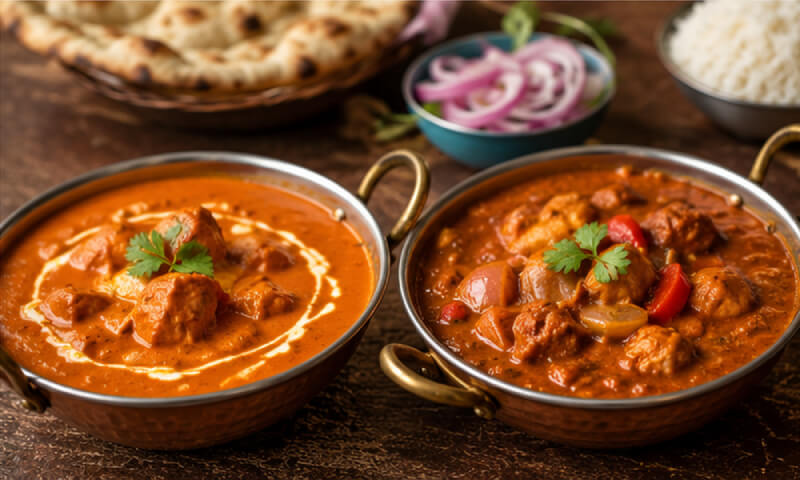
Butter chicken is a two rather than a one because of the Kashmiri chilli in the gravy, which is there almost entirely for colour. It looks hotter than it is. We’ve written a whole post on whether butter chicken is spicy, because the question comes up that often.
Then the makhani family: Paneer Butter Masala, Fish Butter Masala, Butter Prawns. Same gravy, different thing sitting in it. And Malai Kofta, the richest dish we make and about as gentle as food gets. If this band is where you live, we’ve written a full guide for you.
The middle, four to six
This is where most of the good eating is, and it’s the band Australians under-order.
Chicken Tikka Masala at a four is the natural next step from butter chicken, with real garam masala warmth and a yoghurt tang that butter chicken doesn’t have. Lamb Rogan Josh at a five is our pick for the best mid-heat dish on the menu. Slow-cooked, deep, and the Kashmiri chilli gives an aromatic warmth rather than a sting. If you order one thing from the middle, order this.
Karahi and Jalfrezi at a six are a different sort of heat. Green chilli and black pepper rather than dried red, which hits at the front of the mouth and fades faster. Some people find a six on green chilli easier than a five on red.
The hot end, seven to ten
Dhansak at a seven is odd and worth trying. Lentils, lamb and a sweet-sour edge, so the heat arrives after the sweetness. It confuses first-timers in a good way.
Madras at an eight is coconut, tamarind and a lot of chilli. People assume coconut means mild. It doesn’t. Coconut gives the chilli something to sit in. Vindaloo at a nine adds vinegar, so it’s sharp as well as hot, and that combination is what people either love or can’t stand.
Laal Maas at ten is the real thing. Rajasthani lamb cooked with a lot of dried red chilli and yoghurt, no tomato and no cream anywhere. Traditionally it uses Mathania chillies, which give colour as much as heat. Jasvinder grew up on this dish and it’s the one he’s proudest of. Don’t make it your first hot curry. Work up.
About vindaloo and its reputation
Vindaloo in Britain and Australia means “the hottest thing on the menu, ordered on a dare”. That reputation has almost nothing to do with the dish it’s named after.
The original is Goan, and it descends from a Portuguese preparation called carne de vinha d’alhos, meat in wine and garlic. Goa was a Portuguese colony for over four centuries. When the dish was adapted locally, palm vinegar replaced the wine and chilli went in. The name is a corruption of the Portuguese, not a Konkani word for hot, and the “aloo” in it has nothing to do with potato.
A traditional Goan vindaloo is hot, but sourness matters at least as much as heat, and there’s a sweetness underneath from the slow-cooked onion and spice. It’s a balanced dish.
What happened next is that curry houses in Britain from the 1960s onward built an escalating heat ladder for their customers, and vindaloo got a rung near the top, above madras. From there it became a competitive sport, and phaal was invented above it purely to have somewhere hotter to go. That ladder is a British restaurant invention and it doesn’t exist in India.
So when we cook a vindaloo we cook it hot, because that’s what people order it for. But the sourness matters, and if all you’re chasing is heat, Laal Maas is hotter and a better dish.
Green chilli, red chilli and where heat lands
Not all heat is the same shape, and this affects which dishes suit you.
Fresh green chilli, used in jalfrezi and karahi, hits fast and high in the mouth and drops away within a minute. Dried red chilli, used in madras, vindaloo and laal maas, builds slower, sits at the back of the throat, and stays. Black pepper is different again, a dry heat that spreads rather than spikes.
Plenty of people who say they can’t handle spicy food are fine with green chilli and undone by dried red. If you’ve had one bad experience, work out which kind it was before writing off the hot half of the menu.
Ordering hot for a table
Don’t order everything at medium. It’s the most common table decision and the worst one, because you end up with four dishes that all taste like the same amount of nothing in particular. Order at the extremes instead: one genuinely mild dish, one genuinely hot one, and let people serve themselves. Get a raita, order more rice than you think you need, and if something lands too hot the fix is yoghurt or rice, never water and definitely not beer.
A Toowoomba note
Heat orders here follow the weather more than you’d expect. Toowoomba is genuinely cold from May through August, and that’s when vindaloo and madras climb. Same instinct that has people ordering laksa in July.
The other reliable pattern is the end of the week. Thursday to Saturday nights bring the tables who order Laal Maas, usually one person talking the other three into it. Carnival of Flowers in September is the opposite, mostly visitors playing it safe with butter chicken.
Frequently asked questions
What is the hottest Indian curry?
On our menu, Laal Maas, a Rajasthani lamb dish built on dried red chilli. Vindaloo and madras come next. Across India generally, dishes from Andhra Pradesh and Rajasthan are the hottest regional cooking. Phaal, often called the hottest curry, is a British restaurant invention rather than an Indian dish.
Is vindaloo the hottest curry?
Not on our menu. Laal Maas is hotter. Vindaloo’s reputation as the hottest thing available comes from British curry house menus of the 1960s and 70s, which arranged dishes on a heat ladder for customers. The original Goan dish is hot but sour and balanced, not extreme.
What’s the difference between mild, medium and hot when I order?
It’s the amount of chilli we add to a dish that already has its own character. Ordering a madras mild gives you a madras with less chilli, not a korma. Use it to fine-tune within a dish, and change dishes if you want a real jump in heat.
Does coconut make a curry mild?
No. Coconut adds body and a little sweetness, but it doesn’t remove chilli. Madras is coconut based and it’s one of the hotter dishes we serve. Cream and cashew genuinely do soften heat, which is why korma and butter chicken are mild.
What should I drink with a hot curry?
A lassi or anything yoghurt based, or water alongside plenty of rice. Beer feels right and doesn’t help much, because carbonation and alcohol both make capsaicin worse in the short term. We’re licensed and we’ll happily pour you one, we just won’t pretend it’s cooling you down. Korma, for the record, is milder than butter chicken.
Can you make a hot dish mild?
Most of the time, yes, and we’re happy to. Vindaloo, madras and Laal Maas are the exceptions we’ll argue about, because heat is structural in all three. Making them mild leaves you with a dish that isn’t really itself. We’ll steer you to a rogan josh instead.
How hot is medium at an Indian restaurant?
It varies enormously between kitchens, which is why the question is hard to answer honestly. At Ice n Spice, medium on a rogan josh is comfortable for most Australian diners. If you’re unsure, order mild the first time. We’d rather adjust up next visit than have you leave a plate.
Which hot curry is best for a first attempt?
Lamb Dhansak or Karahi Chicken. Dhansak has sweetness carrying the heat, and karahi uses green chilli and black pepper, which fade faster than dried red chilli. Both give you a real hot-curry experience without the sustained burn of a madras.
If you’ve been ordering butter chicken for ten years, the Lamb Rogan Josh is the honest next step, and the Laal Maas is there when you’re ready for it. Both are on the full menu, and if you’d rather try two dishes in one sitting, the lunch thali is the cheap way to do it.