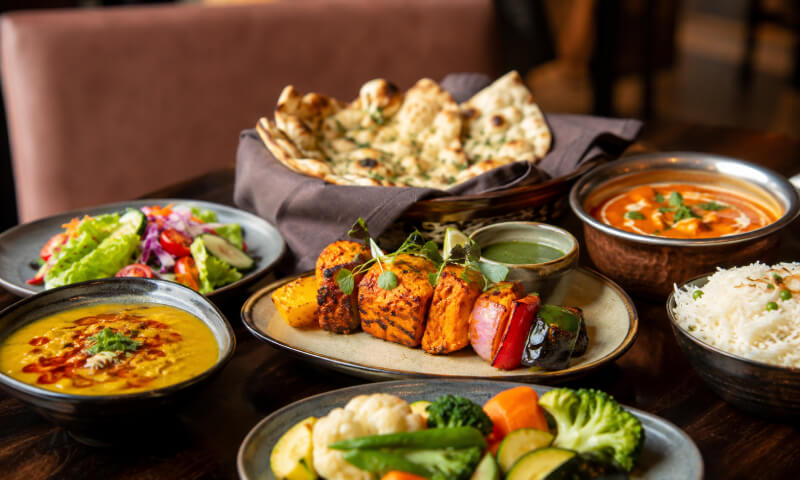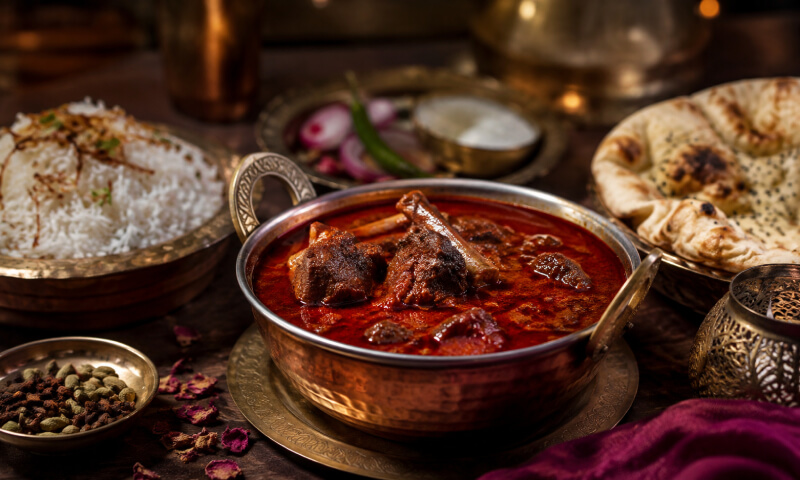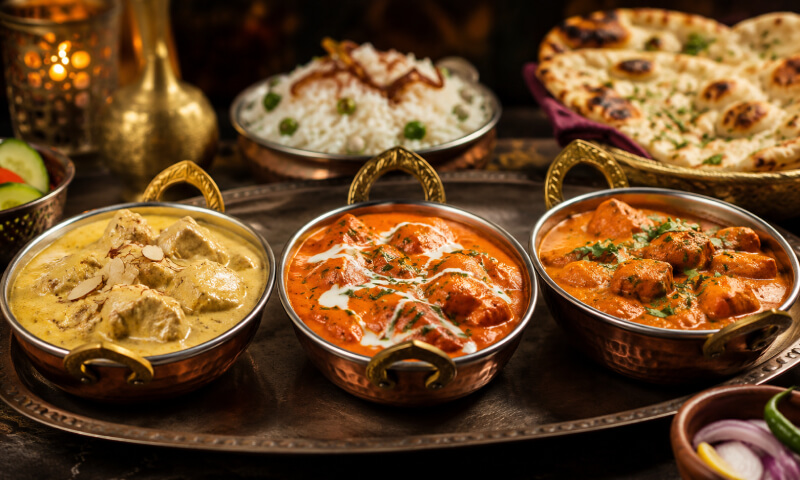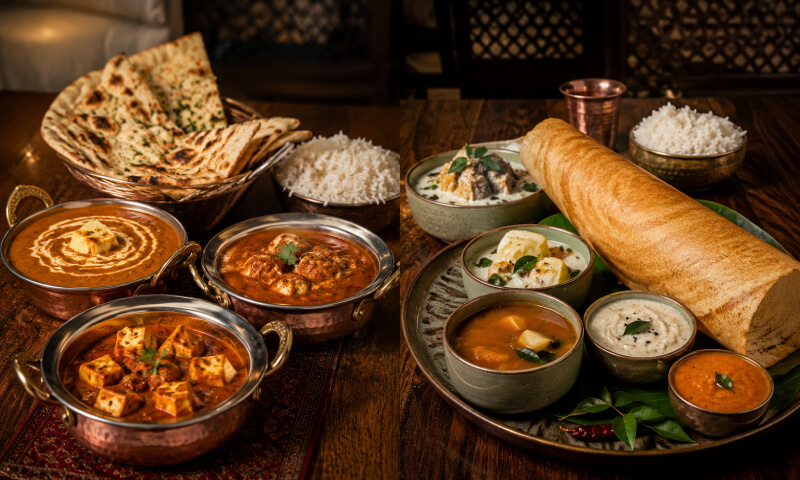
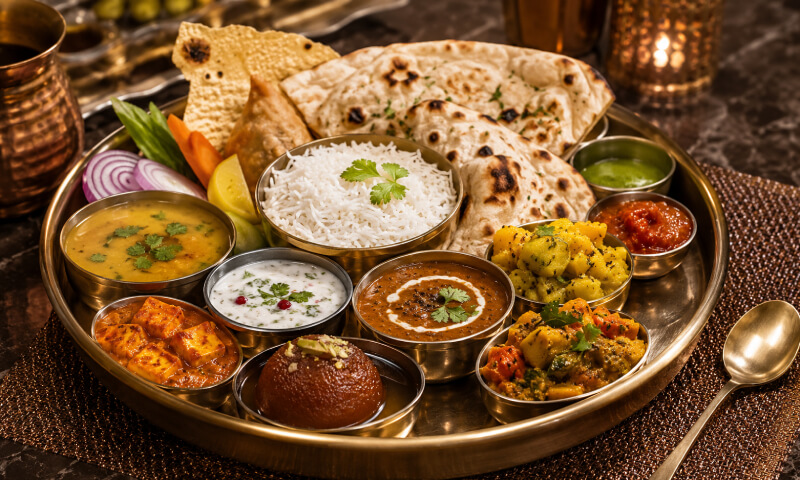
A thali is a complete Indian meal served on one platter, made up of several small portions rather than one large dish. It usually includes a curry or two, rice, bread, and often dal, pickle and yoghurt. The word means “plate”. It’s the everyday format of eating in India, not a special occasion menu.
The plate and the idea
Thali means plate. That’s the literal translation, and the name comes from the round metal platter the meal is served on, usually steel or brass, with small bowls called katoris sitting on it.
But the word has come to mean the meal as well as the dish it’s served on, and the meal is the interesting part. A thali is built so that one platter gives you everything: something rich, something light, something sour, something sweet, plus a carbohydrate to carry it all. You get a small amount of each rather than a large amount of one.
That’s how most of India actually eats. Lunch in a home, in an office canteen, on a train, in a roadside dhaba. It’s not a restaurant invention or a tasting menu.
What’s usually on one
There’s no fixed contents, but the logic behind a thali is fairly consistent.
One or two curries. Usually a vegetable dish and either a second vegetable or a meat, depending on the region and the household.
Dal. Almost always. Lentils are the backbone of the meal and the thing that makes the rest of it balance.
Rice. Plain, or a simple flavoured rice.
Bread. Roti, chapati, paratha or naan depending on where you are.
A sour or sharp element. Pickle, usually just a small spoonful. It’s intense and it’s not meant to be eaten like a side dish.
Yoghurt. Plain curd or raita, which cools the hot elements and settles the meal.
Sometimes a sweet. A small piece of something at the edge of the platter.
The proportions matter as much as the contents. Nothing on a thali is a full serve. You’re meant to eat across all of it rather than through one item at a time, and the flavours are chosen to bounce off each other. Rich next to light, hot next to cool, sour next to bland.
The regional differences
A thali in one part of India looks nothing like a thali 800 kilometres away, which is worth knowing before you assume you’ve had one.
Rajasthani, which is where Jasvinder grew up. Dry, hot, and built around the fact that Rajasthan is desert and vegetables were historically scarce. Dal baati churma is the famous combination. Lots of gram flour, lots of dried chilli, less fresh produce than anywhere else in India. It’s the least creamy Indian food most Australians will ever encounter.
Gujarati. Usually vegetarian, often with a sweetness running through the savoury dishes that surprises people the first time. Frequently unlimited, with servers walking the room topping up bowls.
South Indian, particularly Tamil and Kerala. Rice at the centre rather than bread, sambar and rasam, coconut through everything, often served on a banana leaf rather than a metal platter. In Kerala the sadya version can run to two dozen items.
Punjabi. The richest. Butter, cream, paneer, thick dals, and the breads most Australians recognise.
Bengali. Served in a set order rather than all at once, starting bitter and finishing sweet, with fish almost always present.
So “thali” describes a format, not a recipe. What arrives depends entirely on where the kitchen is from.
How it differs from a set menu or a buffet
Three things get confused with each other, so let’s separate them.
A buffet is self-service from a hot line. You choose, you take as much as you want, and the food has usually been sitting in a bain-marie for a while. The economics push kitchens toward dishes that hold up under a heat lamp, which is a real constraint on quality. We don’t do a buffet at Ice n Spice, and that’s a deliberate decision rather than an oversight. Everything’s cooked to order.
A set menu is a fixed sequence of courses at a fixed price, usually entree, main and dessert, arriving one after the other. It’s a European structure with Indian food in it.
A thali is neither. Everything arrives at once on one platter, in portions decided by the kitchen, and it’s eaten as one meal rather than as courses. Nothing has been sitting under a lamp, because a thali is plated to order. And the portioning is the point, not a limitation. Somebody has decided how these dishes work together.
If you want to feed a group rather than one person, that’s a banquet, and we cover that on our group dining page.
The Ice n Spice Lunch Thali
Ours is deliberately simple. Two dishes with rice and bread, 20to25.
You choose the two dishes. That’s the part people don’t always realise, and it’s what makes it good value rather than just a cheap lunch. You’re not getting the kitchen’s leftovers arranged on a tray. You’re getting two proper curries at a smaller size, cooked when you order them.
It’s lunch service only, 11:30am to 2pm, seven days. It isn’t available at dinner. That catches people out, so it’s worth planning around.
Our advice on choosing the two: don’t pick two from the same family. Two creamy curries on one platter taste like one dish. Pick one rich and one that isn’t. Butter Chicken and Yellow Dal Tadka. Chicken Tikka Masala and Aloo Gobi. Lamb Rogan Josh and Channa Masala. There’s a full explanation of the families in our types of Indian curry guide.
Why it’s the best way to test a kitchen
Here’s the honest argument for ordering one, and it’s not really about the price.
Any Indian kitchen can make a good butter chicken. It’s a forgiving dish. Tomato, butter and cream cover a multitude of shortcuts, and sugar covers the rest. Judging a restaurant on its butter chicken tells you almost nothing.
Judging it on two dishes at once tells you a great deal. If the two curries on your platter taste like variations of the same gravy with different amounts of cream and chilli, the kitchen is working from one base gravy made in the morning, which is what a lot of places do. If they taste like two genuinely different dishes, they’re cooking properly.
The dal is the other tell. Dal is cheap, unglamorous, and impossible to fake. A kitchen that makes a good Yellow Dal Tadka is a kitchen that cares about the food nobody photographs.
So: order a thali with one familiar curry and one dal, and you’ll know within about four mouthfuls whether to come back for dinner. Twenty to twenty-five dollars is a cheap way to find that out.
Eating one properly
Small stuff that makes it better.
Start with a bit of rice and add one dish at a time to the edge of your plate rather than mixing everything together at the beginning. The point of the format is contrast, and mixing it all at the start removes it.
Use the bread for the thicker dish and the rice for the wetter one. If there’s pickle, take a very small amount. It’s a seasoning, not a side.
And eat across the platter rather than finishing one bowl before starting the next. A thali is designed so that each mouthful is slightly different from the last.
A Toowoomba note
The lunch thali does most of its work between about 12 and 1:30, and it’s mostly people working in the CBD who have an hour and want something better than a sandwich. Margaret Street traffic is what it is at lunchtime, so it’s worth ringing ahead on 07 4659 7777 if you’re tight for time.
The other group we see is people trying us for the first time before committing to a dinner booking, often before a bigger night out or during the Carnival of Flowers in September when there are more visitors in town. That’s exactly the right use for it.
Frequently asked questions
What does thali mean?
It literally means “plate” in Hindi and several other Indian languages, referring to the round metal platter the meal is served on. Over time the word came to mean the meal itself: a complete meal of several small portions served together on one platter rather than as separate courses.
What’s included in a thali?
Typically one or two curries, dal, rice, bread, a small amount of pickle, and yoghurt or raita, sometimes with a sweet. Contents vary hugely by region. Our Lunch Thali is two dishes of your choosing with rice and bread, 20to25, at lunch service only.
Is a thali the same as a buffet?
No. A buffet is self-service from a heated line, with food that’s been held rather than cooked to order. A thali is plated in the kitchen and cooked fresh, in portions chosen to balance each other. We don’t run a buffet at Ice n Spice. Everything is cooked when you order it.
Is a thali vegetarian?
Often, but not always. Gujarati and many South Indian thalis are entirely vegetarian, while Punjabi and Rajasthani versions frequently include meat. Ours lets you choose, so you can build a vegetarian, vegan or meat thali. Our vegan and vegetarian page covers what’s suitable.
How much does a thali cost?
Ours is 20to25 depending on which dishes you choose. That’s for two curries with rice and bread, which makes it the cheapest way on our menu to eat two different dishes in one sitting. Full pricing is on the menu.
When is the lunch thali available?
Lunch service only, 11:30am to 2pm, seven days a week. It isn’t available at dinner, which runs 4:30pm to 9pm. If you want two dishes at dinner, order two curries to share instead, which our ordering guide explains.
Can I choose what goes in my thali?
Yes. You pick the two dishes. We’d suggest choosing from two different styles rather than two creamy curries, since two similar gravies on one platter blur into each other. Butter Chicken with a Yellow Dal Tadka, or a Lamb Rogan Josh with an Aloo Gobi, both work well.
Is a thali enough food for one person?
For most people at lunch, yes. Two curries with rice and bread is a full meal, and the portioning is designed to fill you without leaving you heavy for the afternoon. If you’ve got a big appetite, add a bread or a rice from the menu.
Can I get a thali as takeaway?
Yes, during lunch service. Curries and rice travel well. Bread is the item that suffers most on a drive, so eat that first. More on what holds up in our Indian takeaway page.
Is a thali spicy?
Only as spicy as the dishes you choose. Every curry is cooked mild, medium or hot, so you can build a thali with no chilli in it at all. If you’re unsure where things sit, our heat level ranking puts every dish on a scale.
If you’ve never eaten at Ice n Spice, the lunch thali is where we’d start you: two dishes, rice and bread, between 11:30am and 2pm on Margaret Street. Pick one curry you already know and one you don’t. Everything’s on the full menu, and lunch is quiet enough that we can talk you through the choices.