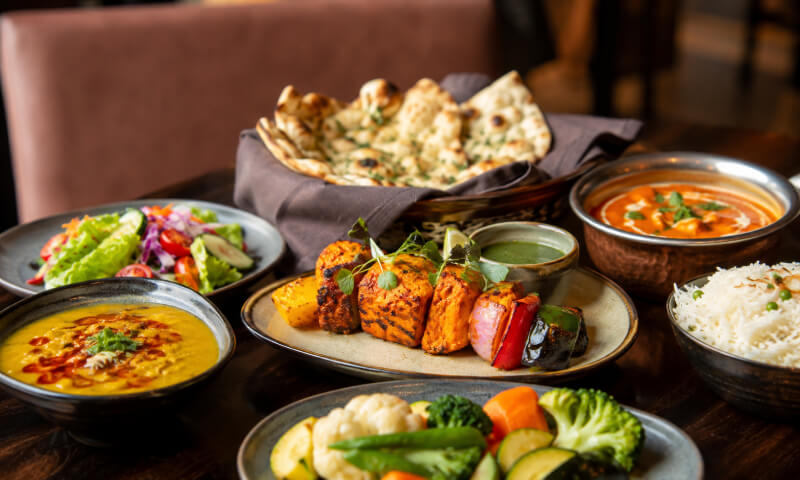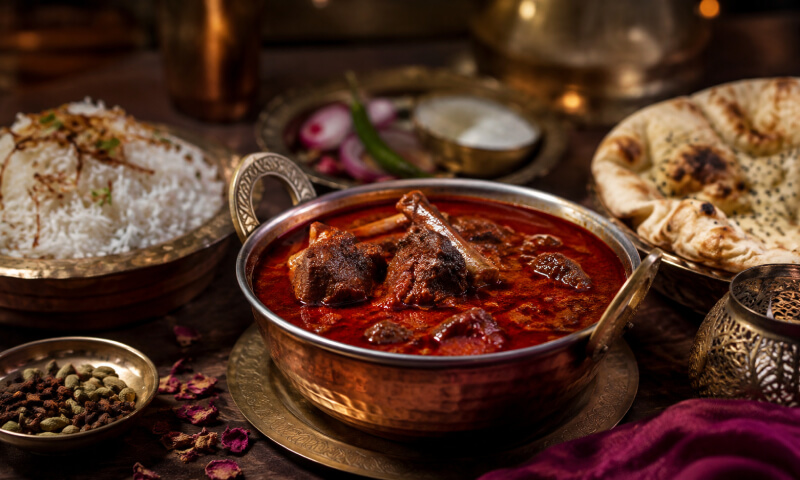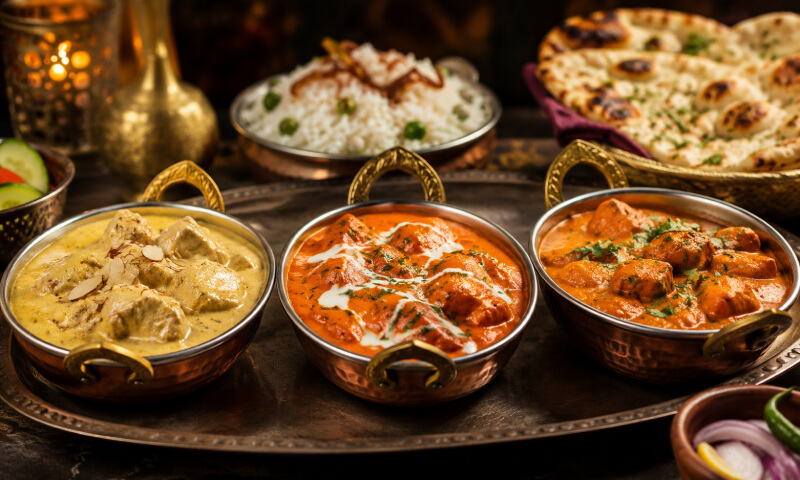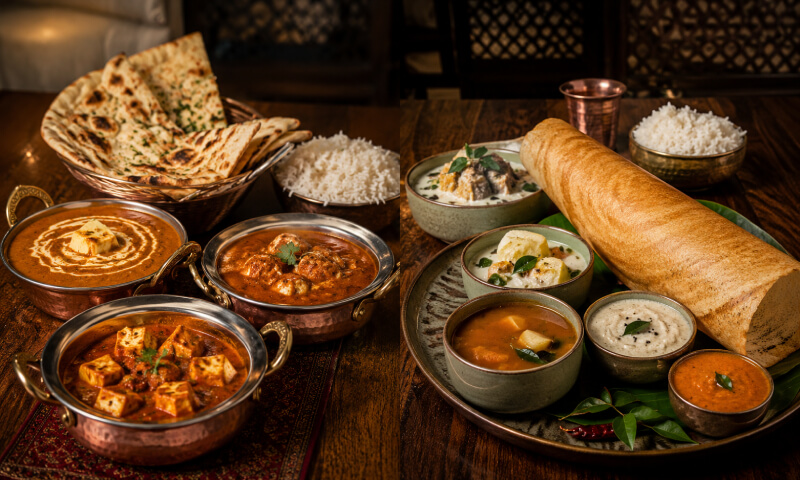
Vegetarian Indian dishes fall into a handful of families: lentil dishes like dal, paneer curries, potato and vegetable dishes such as aloo gobi, legume dishes like channa masala, and mixed vegetable curries. India has more vegetarian cooking than any other major cuisine, so these are full main courses in their own right rather than meat dishes with the meat removed.
Why India cooks vegetarian food better than anywhere else
This isn’t a close contest. A large share of India’s population eats no meat at all, and has done for a very long time, for reasons of religion, region and household custom rather than any recent health trend.
The consequence for cooking is enormous. When a whole culture’s main meals have to be vegetarian, the vegetarian dishes get the attention that meat dishes get elsewhere. Cooks spend centuries working out how to build depth without meat: how to get body from lentils, richness from dairy and nuts, texture from paneer and potato, and savouriness from browned onion and toasted spice.
Compare that with most European cuisines, where vegetarian cooking has mostly meant taking a meat dish and removing the meat. Indian vegetarian food was never a subtraction. Dal Makhani wasn’t designed as an alternative to anything. It’s the main event, and always was.
Jasvinder grew up in Rajasthan, which pushes this further than most places. Rajasthan is desert, fresh vegetables were historically scarce, and the local cooking got very good at making substantial food out of lentils, gram flour and dried spice. We’ve written about that in more detail in our Rajasthani food post.
Which makes it the easiest cuisine in Australia to eat well as a vegetarian
If you’re vegetarian in Toowoomba on a Friday night, most restaurants offer you one pasta, one risotto and a salad. At an Indian restaurant you get a section of the menu with thirteen mains on it, none of them designed around your absence.
That’s the real argument. It isn’t that Indian food happens to accommodate vegetarians. It’s that a third of the menu was always going to be there whether you turned up or not.
The categories, and the dishes on our menu
Lentils: Dal Makhani and Yellow Dal Tadka
Dal is the backbone of Indian home cooking and the dish we’d judge any kitchen on. It’s cheap, unglamorous and impossible to fake, which is why it tells you the truth about a restaurant.
Yellow Dal Tadka is the everyday one. Yellow lentils cooked down soft, then finished with a tadka: whole spices bloomed in hot fat and poured over the top at the last second. Light, savoury, comforting. It’s the dish we’d order every time if we could only have one. It’s also vegan if it’s made with oil instead of ghee, which we’re happy to do, so ask.
Dal Makhani is the opposite end. Black lentils and kidney beans cooked slowly with butter and cream until the texture goes thick and almost glossy. Rich, dark, and closer to a main course than a side. Not vegan, obviously, given what the name means.
Paneer: four different dishes, not four versions of one
Paneer is fresh cheese, and it gives vegetarian dishes the substance that meat gives elsewhere. We have four, and the mistake people make is ordering two that do the same job.
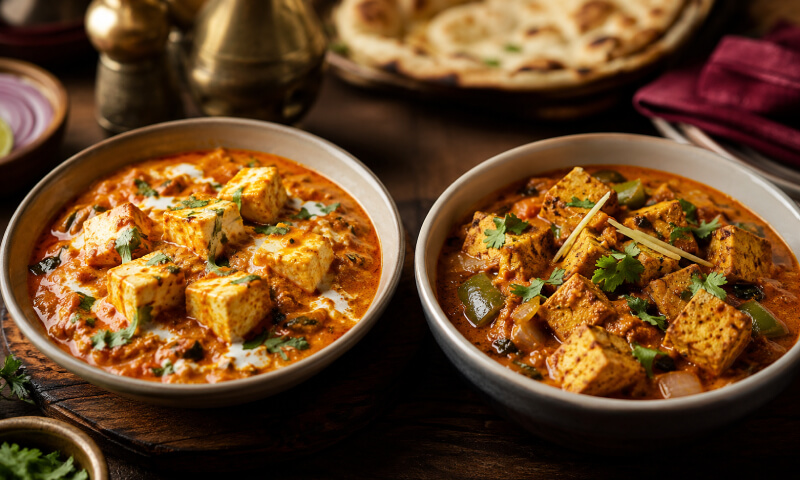
Paneer Butter Masala is butter and tomato, mild and slightly sweet, and the closest vegetarian equivalent to butter chicken. Shahi Paneer is richer again, cream and ground nuts rather than tomato. Palak Paneer is spinach based, savoury and green, and the one we’d push hardest. Karahi Paneer is drier and more assertive, cooked with capsicum and onion.
None of these are vegan. Paneer is dairy, and that catches people out often enough that we wrote a whole post on paneer versus tofu.
Potato: Aloo Gobi, Aloo Baingan and Aloo Palak
Aloo means potato. These three are all vegan as cooked, and all three are drier and more textured than the creamy curries, which makes them useful on a shared table.
Aloo Gobi is potato and cauliflower with turmeric and cumin. The best version has cauliflower with some bite left in it rather than collapsed. Aloo Baingan is potato and eggplant, softer, deeper, a bit smoky. It’s the most underrated dish in the section and hardly anyone orders it. Aloo Palak is potato in the same spinach base as Palak Paneer, and it’s the dish we point vegans at when they’re eyeing the paneer.
Legumes: Channa Masala
Chickpeas in an onion and tomato masala, fairly dry, with a sour edge from the spicing. Vegan as cooked, filling, and probably the best value protein on the menu. If you want one dish that proves vegetarian Indian food doesn’t need cream to be satisfying, this is it.
Mixed vegetable: Vegetable Jalfrezi and Vegetable Korma
Vegetable Jalfrezi is stir-fried vegetables in a thicker, tangier sauce with capsicum and onion, cooked hotter and drier than most of the section. Vegan as cooked.
Vegetable Korma is the mild one. A gentle, slightly sweet gravy built on cream and ground nuts, and the dish we recommend to people who genuinely don’t want chilli. It’s not vegan. If mild is what you’re after, our mild curries guide sorts out which dishes are actually gentle and which just look it.
The special occasion dish: Malai Kofta
Vegetable and paneer dumplings in a smooth, mild, creamy gravy. Malai means cream, so it isn’t vegan and it isn’t light. It takes work to make properly, and it’s the dish to order when you want the vegetarian option to be the best thing on the table rather than the sensible one.
What we’d actually order for a table of four
Here’s the opinionated bit. Three dishes, and they should do three different jobs.
Yellow Dal Tadka. Non-negotiable. It’s the anchor, it costs less than everything else, and it makes every other dish on the table taste better by contrast.
Palak Paneer. Something green and savoury with weight to it. If your table is vegan, swap in Aloo Palak.
Channa Masala or Aloo Gobi. Something dry and textured, so you’re not eating three bowls of gravy.
Then rice and one bread between the table. What we’d avoid is the common order of Paneer Butter Masala plus Vegetable Korma plus Malai Kofta, which is three mild creamy dishes that blur into one another by the fourth mouthful. Order at most one of those three. Our what to order guide has more on balancing a table.
The vegan caveats, spelled out
Vegetarian and vegan are not the same thing on an Indian menu, and the gap catches people out.
Vegan as cooked: Channa Masala, Aloo Gobi, Aloo Baingan, Aloo Palak, Vegetable Jalfrezi.
Vegan on request: Yellow Dal Tadka, if it’s made with oil instead of ghee. Just say so when you order.
Not vegan: anything with paneer (all four paneer curries, plus Chilli Paneer Dry and Paneer Naan), Dal Makhani (butter and cream), Malai Kofta (cream), Vegetable Korma, and every one of our breads, since naan dough contains dairy.
That last one surprises people most. Naan is not vegan, so a vegan meal here runs on rice rather than bread. Ghee, cream and yoghurt turn up in more places than you’d expect, and we’ve mapped all of them in our ghee and hidden dairy post. Our vegan and vegetarian page lists the current dishes.
Frequently asked questions
What are the most popular vegetarian Indian dishes?
Paneer Butter Masala, Palak Paneer, Dal Makhani, Channa Masala and Aloo Gobi cover most of what gets ordered in Australia. On our menu, Paneer Butter Masala is the most ordered by a clear margin, though Yellow Dal Tadka is the one we’d recommend more often.
Is Indian vegetarian food healthy?
The lentil, chickpea and vegetable dishes generally are, since they’re built on legumes and vegetables with modest amounts of oil. The cream-based ones like Dal Makhani, Malai Kofta and Vegetable Korma carry a lot more fat. Our post on whether Indian food is healthy goes through it properly.
Are vegetarian Indian dishes vegan?
Often, but not always, and you can’t tell from the name. Paneer dishes are cheese, Dal Makhani has butter and cream, Malai Kofta and Vegetable Korma are cream based, and all naan contains dairy. Our vegan dishes as cooked are Channa Masala, Aloo Gobi, Aloo Baingan, Aloo Palak and Vegetable Jalfrezi.
What’s the difference between dal and channa masala?
Dal is made from split lentils cooked down until soft, so the texture is loose and soupy. Channa masala uses whole chickpeas that keep their shape in a thicker, drier onion and tomato masala. Both are legumes, but they eat completely differently and work well ordered together.
How many vegetarian dishes do you have?
Thirteen vegetarian mains, plus Chilli Paneer Dry, Veg Samosa, Onion Bhaji and Spring Rolls among the entrees, Vegetable Biryani, and the Lunch Thali, which you can build entirely vegetarian. The full list is on the menu.
Are your vegetarian dishes cooked separately from the meat?
The vegetarian dishes have their own gravies, but it’s one kitchen, so we won’t claim a fully separated vegetarian section. If this matters to you for religious or personal reasons, tell us when you order and we’ll tell you exactly how it’s handled. [CONFIRM: current kitchen practice on separate pans and utensils]
Is Indian vegetarian food gluten free?
Most of the vegetarian curries are, since they’re thickened with onion, tomato, lentils or nuts rather than flour. The breads are not, since all of ours contain wheat, and some entrees are crumbed or wrapped. Check the (GF) markers or ask us. There’s more on the gluten free page.
Can vegetarians eat biryani?
Yes. Our Vegetable Biryani is layered rice with spiced vegetables, cooked the same way as the meat versions. It’s a full meal on its own rather than something to share, which is worth knowing before you also order curries.
If you’ve been ordering the same paneer dish for years, order Yellow Dal Tadka alongside it next time and see which one you finish first. We’re on Margaret Street, lunch from 11:30 and dinner from 4:30, seven days a week.