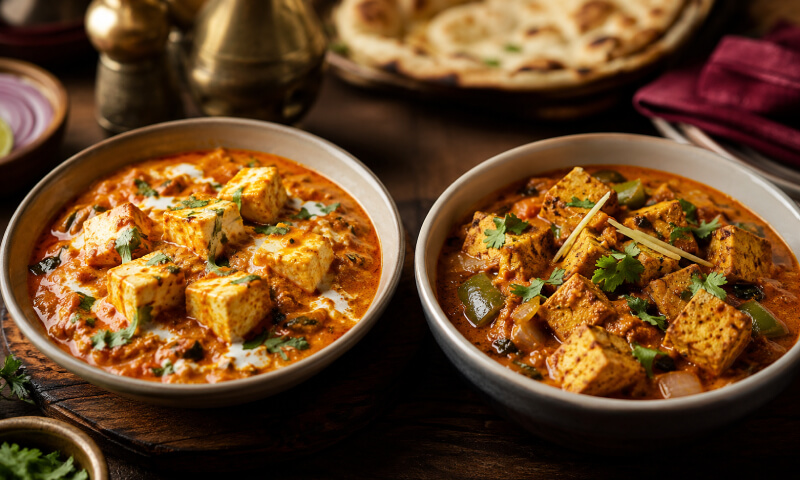
Paneer is a fresh cheese made by curdling milk with acid, so it’s vegetarian but not vegan. Tofu is made by setting soy milk, so it’s both. Paneer is firmer, richer and doesn’t melt. Tofu is softer, blander and takes on whatever it’s cooked in. They behave differently in a curry and aren’t a straight swap.
What paneer actually is
Paneer is cheese, made about as simply as cheese can be made. Milk is heated, an acid goes in (lemon juice, vinegar or whey from an earlier batch), and it splits into curds and liquid. The curds are strained through cloth and pressed into a block. That’s the whole process, and it takes under an hour.
Two things make it unusual among cheeses. There’s no rennet, which is why it suits vegetarians who avoid rennet-set cheeses. And there’s no ageing, so it has none of the sharpness that comes from time.
The important consequence for cooking is that paneer doesn’t melt. Acid-set cheese has a protein structure that stays put under heat. It browns, it firms up slightly, it can go rubbery if you push it too far, but it holds its shape in a simmering gravy the way haloumi does on a grill. That’s the whole reason it works in a curry.
The flavour is mild and milky with a faint sweetness. Not bland, but not assertive either. It’s there to carry a gravy and give a vegetarian dish some weight.
What tofu is
Tofu runs on the same logic with soy instead of dairy. Soy beans are soaked, ground and strained into soy milk, a coagulant goes in (usually calcium sulphate or nigari), and the curds are pressed into blocks. Longer pressing gives firmer tofu.
The texture range is much wider than paneer’s. Silken tofu is barely set and collapses if you look at it. Firm and extra-firm is closer to paneer, though still softer and far more porous. That porousness is the main difference in the pan: tofu absorbs, paneer resists.
Tofu is also blander. It has a faint bean note and not much else, which is a strength when you want the sauce doing the talking and a weakness when the dish needs something with character of its own.
Head to head
Texture. Paneer is dense and springy with a slight squeak. Tofu is softer and more crumbly, even the firm blocks. Paneer gives you something to chew. Tofu yields.
Protein. Both are decent sources. Paneer carries somewhat more per 100 grams than most firm tofu, along with considerably more fat, most of it saturated. Tofu is leaner and has no cholesterol. On protein per calorie, tofu wins comfortably.
Flavour. Paneer tastes of milk. Tofu mostly tastes of what you put on it. That changes what the dish needs. A gravy built for paneer is seasoned assuming the cheese will soften it, so tofu in the same gravy tastes sharper than intended.
Behaviour in a curry. Paneer holds its cubes and stays distinct in the sauce. Tofu soaks the sauce up, which sounds appealing until the cubes lose definition and the gravy loses liquid. Tofu also breaks apart if it’s stirred much. Anyone who’s tried palak paneer with tofu knows it ends up closer to a spinach scramble.
Dietary status. Paneer is vegetarian. It is not vegan, not dairy free, and not suitable for anyone avoiding lactose. Tofu is vegetarian, vegan, dairy free and lactose free, though it’s obviously out for anyone with a soy allergy. This is the difference that actually matters most often, and it’s the one people get wrong.
Paneer is vegetarian, not vegan
We’ll say this plainly, because it comes up at the counter most weeks. Paneer is cheese, made from milk. A dish with paneer in it is never vegan, however many vegetables are in the rest of it.
The confusion is understandable. Paneer sits in the vegetarian section of every Indian menu in the country, it looks like tofu, and it turns up in dishes full of spinach and tomato. But it belongs with cream and yoghurt, and it’s one of several places dairy hides in Indian food where people don’t expect it. We’ve mapped the rest in our guide to ghee and hidden dairy.
The flip side: paneer is good news if you’re vegetarian rather than vegan. It’s the reason Indian food gives vegetarians proper main courses instead of a side salad with the meat left out.
The paneer dishes at Ice n Spice
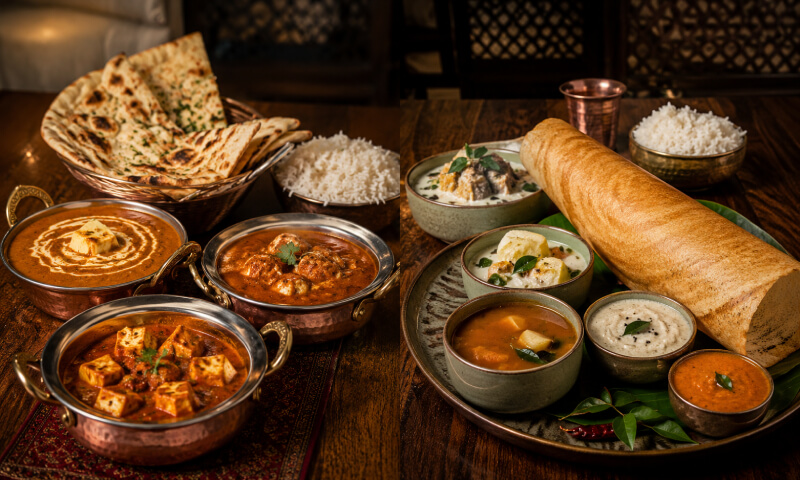
We have four paneer curries on the menu, plus two other places it shows up. They’re not variations on one dish, which is worth knowing before you order.
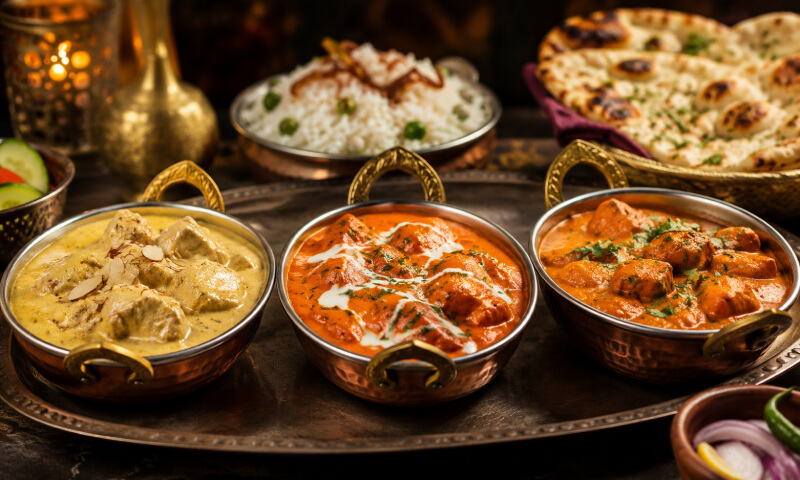
Paneer Butter Masala. Butter and tomato gravy, mild, slightly sweet, with masala meaning the spice mix behind it rather than a flavour. The one to order if you like butter chicken and want the vegetarian equivalent, and the most popular of the four by a distance.
Shahi Paneer. Richer again. Shahi means royal, and the gravy leans on cream and ground nuts rather than tomato, so it’s paler and sweeter. Don’t order it alongside the butter masala, because two rich gravies on one table cancel each other out.
Palak Paneer. Spinach, and the one we’d push. Green, savoury, faintly iron-ish, with the paneer standing out against it. If you’ve only had paneer in creamy tomato gravies, this is the dish that shows you what the cheese is for.
Karahi Paneer. Cooked in a karahi with capsicum and onion, drier than the others, more assertive with the spice. The best choice if you don’t want a heavy gravy at all.
Beyond the curries, Chilli Paneer Dry is on the entree list. Indo-Chinese rather than Indian in origin, fried paneer tossed with chilli, onion and capsicum, and a good thing to put in the middle of the table while people are still deciding. Paneer Naan is stuffed with spiced paneer and is close to a meal on its own. Our vegetarian Indian dishes guide runs through all thirteen mains.
Can you order tofu instead? No, and here’s what to do
We don’t substitute tofu for paneer. It isn’t a small thing to swap, and we’d rather say so than serve a version of a dish that doesn’t work.
Two reasons. Tofu behaves differently enough in our gravies that a Palak Paneer made with it is a different meal wearing the same name. And the richer gravies contain dairy anyway, so a tofu swap wouldn’t make Paneer Butter Masala or Shahi Paneer vegan even if we did it.
What we point vegan diners to instead, all vegan as cooked: Channa Masala, Aloo Gobi, Aloo Baingan, Aloo Palak and Vegetable Jalfrezi. Yellow Dal Tadka is vegan made with oil instead of ghee, so ask and we’ll do it that way.
For the closest thing to the paneer experience without dairy, order Aloo Palak. Same spinach base as Palak Paneer with potato instead of cheese, and a genuinely good dish rather than a consolation. Our vegan and vegetarian page has the full list.
One Toowoomba note. We get a steady run of tables where one person is vegan and the rest aren’t. What works best is two or three vegan dishes in the middle of the table rather than one plate for one person. Nobody gets catered for separately, and the rest of the table eats them anyway.
Frequently asked questions
Is paneer vegan?
No. Paneer is a fresh cheese made from milk, so it’s vegetarian but never vegan. Any dish with paneer in it is out for vegans, including Paneer Butter Masala, Shahi Paneer, Palak Paneer, Karahi Paneer, Chilli Paneer Dry and Paneer Naan. Our vegan options are the potato, chickpea and mixed vegetable dishes instead.
Is paneer healthier than tofu?
It depends what you’re measuring. Tofu is lower in fat and calories, has no cholesterol, and gives more protein per calorie. Paneer has more protein per 100 grams and more calcium, but considerably more saturated fat. Neither is a health food or a problem in a normal meal.
Does paneer melt?
No, and that’s the point of it. Acid-set cheeses with no rennet hold their structure under heat, so paneer keeps its cubes in a simmering gravy instead of dissolving into it. It will firm up and eventually go rubbery if it’s cooked too long or too hot, which is why it goes into a curry late.
Can I use tofu instead of paneer at home?
You can, but treat it as a different dish rather than a substitution. Use extra-firm tofu, press it, and fry or bake the cubes first so they hold together. Add it at the very end and stir as little as possible. Expect a sharper gravy, since it was seasoned for something milky.
Is paneer suitable for lactose intolerance?
Generally no. Paneer is fresh and unaged, so it holds more lactose than hard aged cheeses do. People with mild intolerance sometimes manage small amounts, but we wouldn’t recommend it if you react reliably. Our vegan dishes are the safer choice.
Which paneer dish should I order first?
Palak Paneer if you want to actually taste the paneer, since the spinach gives it something to stand against. Paneer Butter Masala if you like butter chicken and want the vegetarian version of that experience. Both are on the full menu and both are cooked mild, medium or hot.
Is paneer gluten free?
Paneer contains no gluten, and our paneer curries are gluten free as cooked. Paneer Naan is not, since all our breads contain wheat. We were voted number one for gluten free in Toowoomba by local diners, and the gluten free page has the detail.
Is paneer the same as haloumi?
Not the same, but related in behaviour. Both are non-melting cheeses that hold their shape under heat. Haloumi is brined and salty and usually made from sheep or goat milk, while paneer is unsalted, unaged and made from cow milk, which makes it much milder.
If you’re deciding between the four, order Palak Paneer with one of the vegan dishes and put both in the middle of the table. That pairing tells you more about a kitchen than any single curry does. We’re on Margaret Street, seven days.