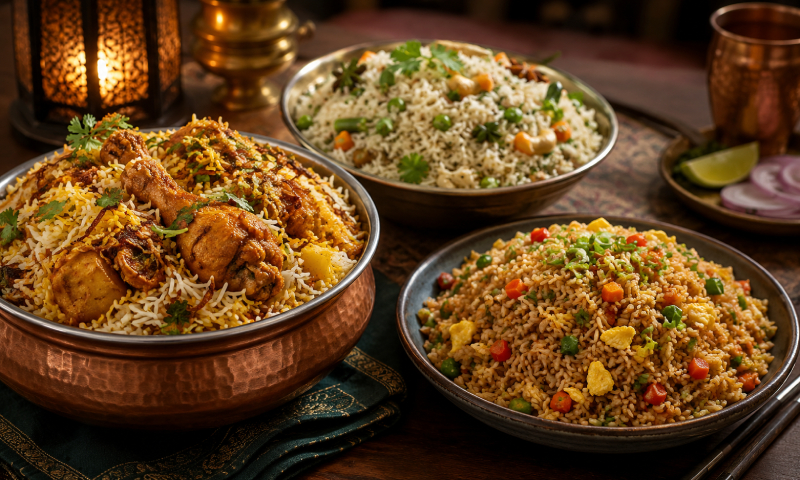
Biryani is a layered rice dish where parboiled basmati and separately cooked marinated meat are stacked in a pot, sealed, and finished over low heat so the steam cooks everything together. That sealing method is called dum. It’s what separates biryani from pulao, where rice and meat are cooked together in one liquid, and from fried rice, where cooked rice is stirred through a sauce.
The method is the dish
Most rice dishes are defined by ingredients. Biryani is defined by a technique, and if you skip the technique you don’t have biryani, you have rice with curry in it.
Here’s the sequence. Meat is marinated in yoghurt with ginger, garlic and a heavy spice blend, and left for hours. Basmati is soaked, then boiled with whole spices until it’s about 70 per cent done, and drained. The two are layered in a heavy pot, meat and gravy at the bottom, rice over the top, with fried onions, saffron milk and herbs between the layers.
Then the pot is sealed, traditionally with a rope of dough pressed around the lid, which bakes hard into an airtight join. It goes over low heat for anywhere from 25 minutes to well over an hour, depending on the meat.
Nothing escapes. The rice finishes cooking in steam carrying the aroma of everything below it. When the seal is broken at the table, the smell that comes out is the whole point of the exercise.
Why stirring ruins it
The thing that makes biryani good is that it isn’t uniform.
The bottom layer is dark, saturated and sitting in gravy. The top is pale, loose and aromatic, closer to a plain rice. A properly served portion cuts down through all of it, so no two mouthfuls are quite the same.
Stir a biryani and you destroy that in ten seconds. You get one flavour, evenly distributed, at a medium intensity. Still perfectly nice food. It just isn’t the dish, and the hours of layering were wasted.
Which is why “biryani” made by stirring cooked rice through a leftover curry is a different thing entirely. So is fried rice, where cooked, cooled rice is tossed in a hot pan with oil. Fried rice is a fast dish built on already-cooked components. Biryani is a slow dish where the rice deliberately finishes cooking inside the assembled pot.
Biryani vs pulao, plainly
Pulao is the older and simpler idea. Rice goes into a pot with stock, spices and whatever meat or vegetables are involved, and it all cooks together, absorbing the liquid until it’s done. Everything tastes the same because everything cooked in the same liquid at the same time.
Biryani is assembled from separately cooked components and finished as a whole.
Three practical differences follow from that. Pulao is milder, because the spice is diluted through the whole cooking liquid rather than concentrated in a marinade. Pulao is faster, often 30 minutes start to finish. And pulao is easier, which is why it’s home food across a lot of North India while biryani turns up for guests and celebrations.
Neither is better. But if a menu lists something as biryani and it arrives looking evenly coloured all the way through with no variation in the pot, what you’ve got is a pulao.
Hyderabadi and Lucknowi, at a high level
Biryani is regional, and there are dozens of versions across the subcontinent. Two are worth knowing because most restaurant biryani descends from one or the other.
Hyderabadi biryani, from the Deccan in southern India, is the more aggressive of the two. The classic version is kachchi, meaning raw marinated meat is layered under parboiled rice and both cook together in the sealed pot. That takes precision, because the two have to finish at the same moment. It’s hotter and sharper, heavier on chilli and fried onion.
Lucknowi biryani, also called Awadhi, comes from the north and reflects the more restrained court cooking of that region. The meat is cooked first, then layered with rice, which is a gentler method. More fragrant than hot, leaning on saffron, rosewater and whole spices.
If you like biryani that punches, you like Hyderabadi. If you like biryani that perfumes, you like Lucknowi. Our style sits closer to the northern end, which follows from Jasvinder cooking out of a Rajasthani and Punjabi background rather than a Deccan one.
Worth saying: the history of biryani is contested. Persian origin, Mughal court origin, and independent Deccan development are all argued for by serious people, and anyone telling you the single true story is overselling their evidence.
Why biryani travels better than anything else
If you’re ordering Indian takeaway and you’re more than ten minutes from the restaurant, biryani is the best thing on the menu to order, and it isn’t close.
Bread is the worst traveller. Naan is at its best about two minutes out of the tandoor and steams itself soft in a container, which we’ve explained in our guide to the types of naan. Thin curries survive but cool fast, because there’s a lot of surface area and not much mass.
Biryani is dense, so it holds heat far longer than a shallow container of curry. It was cooked in trapped steam in the first place, so a sealed container is the environment it was designed for rather than an insult to it. And it’s a complete meal in one container.
It also reheats well, which almost nothing else does. Cover it, add a splash of water, low heat or a medium microwave, and it comes back close to where it started.
Our four biryanis, and an opinion about goat
We serve Chicken, Goat, Lamb and Vegetable Biryani, 22to27. All main-course sized.
Chicken is the safe order and the one most tables choose. Lamb is richer and stands up better to the spice. Vegetable is a genuine dish rather than a consolation prize, though check the markers if you’re strictly vegan, because it isn’t automatically so.
Goat is the one to order. It’s the traditional meat for biryani across most of India, and everything else is an accommodation of it. Goat is working muscle with connective tissue running through it, so it needs the long, slow, sealed cooking that biryani provides anyway. Chicken tolerates that treatment. Goat requires it, and rewards it.
The flavour is stronger and slightly gamier than lamb, which is exactly why it holds up under a heavy spice load. Chicken biryani has to be spiced carefully so the meat isn’t buried. Goat can take everything you throw at it and still taste of goat.
Australian diners order it less than they should, mostly out of unfamiliarity. If you eat lamb, you’ll be fine with goat. Our goat comes from a halal-certified supplier, as do our chicken and lamb, though the venue itself is not halal certified and we serve beef and alcohol on site. There’s more detail on the halal page.
Frequently asked questions
What is biryani made of?
Basmati rice, marinated meat or vegetables, yoghurt, onions, whole and ground spices, and usually saffron. The distinguishing feature is assembly rather than ingredients. The rice is parboiled separately, the meat is cooked or marinated separately, and the two are layered in a pot which is then sealed and steamed together over low heat.
What is the difference between biryani and pulao?
Pulao cooks rice and meat together in one pot of seasoned stock, so the flavour is even and mild throughout. Biryani layers separately cooked rice and meat, seals the pot, and steams them together, which is called dum. Biryani is more strongly spiced and varies bite to bite. Pulao is faster and gentler.
Is biryani the same as fried rice?
No. Fried rice starts with already-cooked, usually cooled rice that’s tossed in a hot pan with oil and other ingredients. It’s fast and it’s stirred. Biryani rice is deliberately undercooked, then finishes steaming inside a sealed pot with the meat below it. Stirring a biryani destroys the layering that defines it.
What does dum mean in dum biryani?
Dum refers to sealing the pot so no steam escapes while the dish finishes cooking on low heat. Traditionally a rope of dough is pressed around the lid, which bakes solid and forms an airtight seal. The trapped steam finishes the rice and keeps the meat moist, and it holds in the aromatics that would otherwise cook off.
Which biryani is best?
Goat, in our opinion. Goat is the traditional meat for biryani and its texture suits the long sealed cooking, where chicken merely survives it. The stronger flavour also holds up under heavy spicing. Lamb is the next best. Chicken is the most popular order but the least interesting of the three.
Is biryani spicy?
Usually more strongly spiced than a plain rice dish, but spiced isn’t the same as chilli hot. Hyderabadi style leans hot. Northern styles like Lucknowi lean aromatic, with saffron and whole spices rather than chilli. We cook to mild, medium or hot across the menu, so tell us where you want it.
How much is biryani at Ice n Spice?
Our biryanis run 22to27, covering Chicken, Goat, Lamb and Vegetable. That’s a main-course portion, so it doesn’t need a side of rice with it. If you’re ordering for a table, one biryani plus a curry or two and some bread feeds three or four people comfortably.
Is biryani good for takeaway?
It’s the best thing on an Indian takeaway menu for travel. It’s dense so it holds heat, it was cooked in trapped steam so a sealed container suits it, and it’s a full meal in one container. It also reheats better than almost anything else. Bread is the opposite, since naan softens within minutes of being boxed.
Is vegetable biryani vegan?
Not automatically. Vegetable biryani commonly includes yoghurt, ghee or cream in the layering, so check the menu markers or ask when ordering. If you’re vegan, plain rice with dishes like channa masala, aloo gobi or vegetable jalfrezi is the reliable route, and there’s more on our vegan and vegetarian page.
If you’ve only ever had chicken biryani, order the goat next time and eat down through the layers rather than mixing it. That’s the dish as it’s meant to be eaten. We’re on Margaret Street, open for lunch and dinner seven days, and biryani is the one thing we’d happily send an hour up the range.