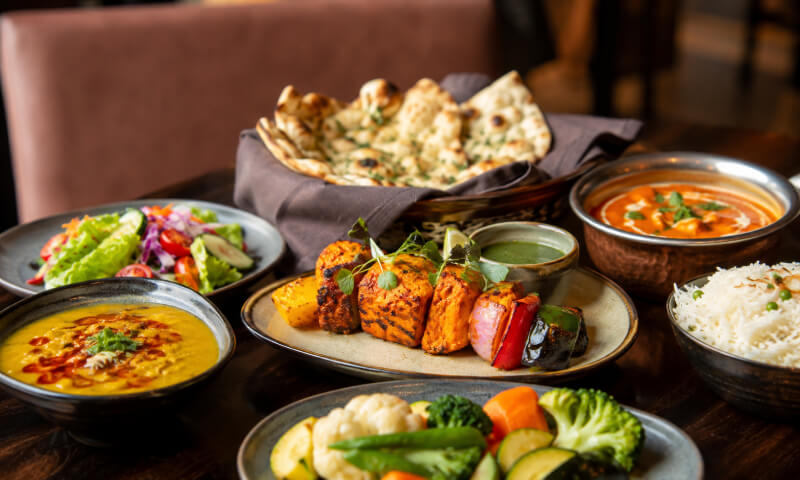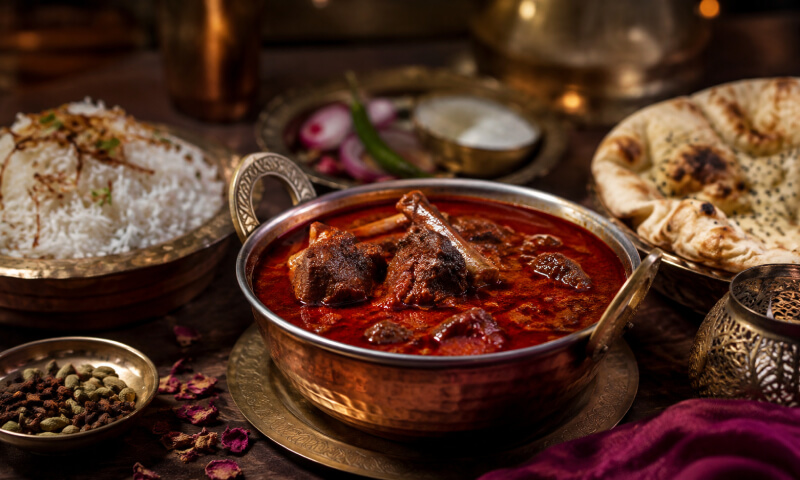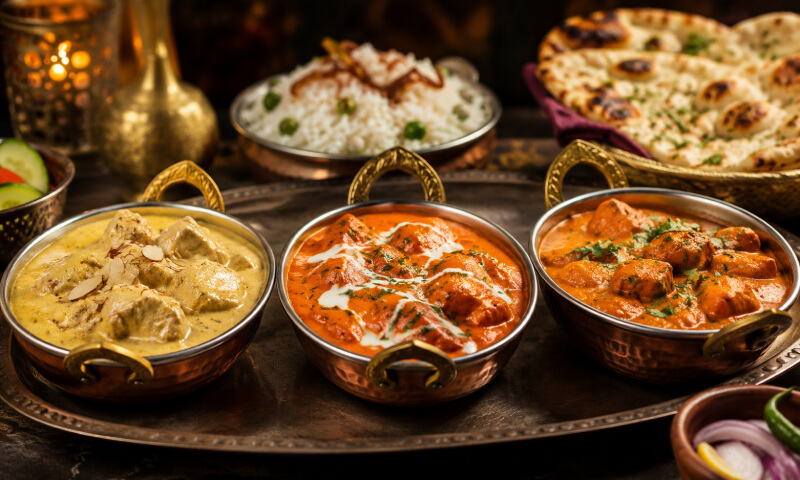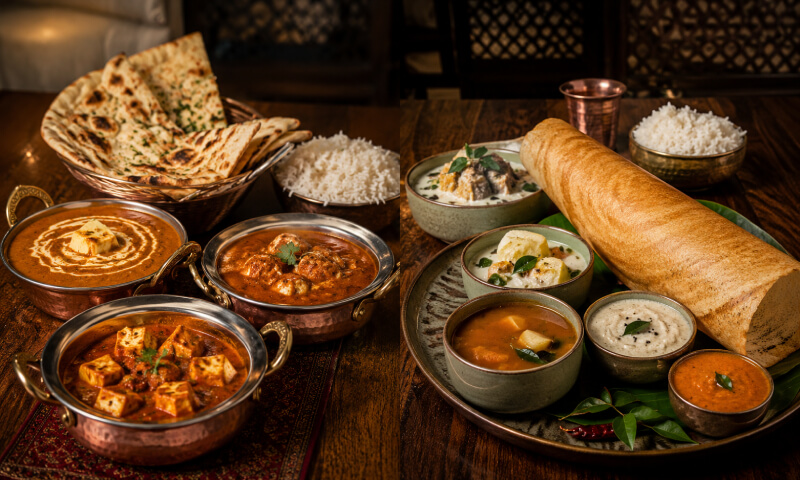
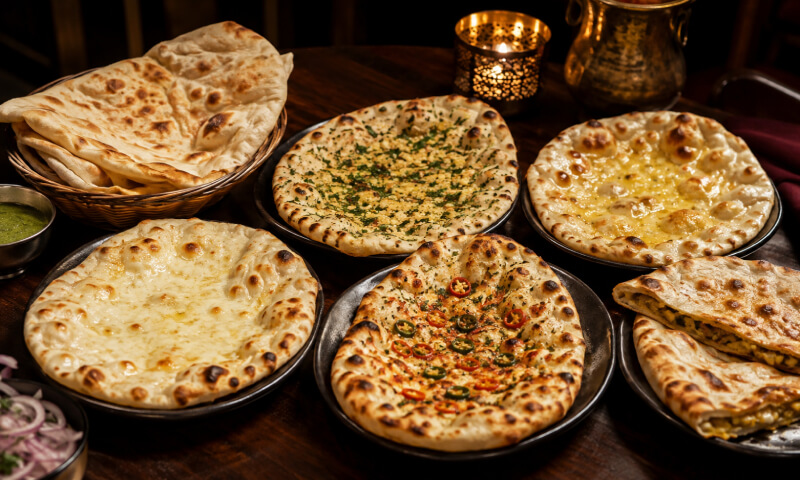
The six types of naan on our menu are Plain Butter Naan, Garlic Naan, Cheese Naan, Paneer Naan, Aloo Stuffed Naan and Chicken Tikka Naan, from 5to8.50. Plain and garlic are the everyday breads that go with any curry. Cheese, paneer, aloo and chicken tikka are stuffed, which makes them closer to a dish in their own right than a side.
What makes naan naan
Naan is leavened white-flour bread baked against the wall of a clay tandoor. The dough uses maida, a fine refined wheat flour, plus yoghurt or milk and a raising agent. That gives it a soft, slightly chewy crumb with irregular air pockets.
It cooks in roughly 90 seconds. The dough is stretched, slapped onto the clay, then pulled off with a hooked rod when it’s blistered and lightly charred in patches. The teardrop shape is not a design choice, it’s gravity dragging the dough down the wall while it bakes.
Every naan we serve comes out of the same tandoor as the Lamb Cutlets and Chicken Tikka, so it picks up charcoal smoke on the way. We’ve covered what a tandoor is separately.
The six, one at a time
Plain Butter Naan
The baseline, and a better bread than most people give it credit for. Soft, slightly sweet from the dairy in the dough, finished with butter. It doesn’t compete with anything.
This is the one to order with the hot end of the menu. Chicken Vindaloo, Lamb Vindaloo, Laal Maas, Prawn Madras. When the curry is doing the heavy lifting, you want bread that carries it, not bread that argues with it. The butter and the dairy also blunt chilli heat, which is a practical benefit at the hot end.
Garlic Naan
The most ordered bread in the place, and it deserves the position. Fresh garlic and coriander worked into the surface before baking, so the garlic toasts rather than staying raw and sharp.
Best with tomato-based and drier dishes where the garlic can meet something. Karahi Chicken, Vegetable Jalfrezi, Channa Masala, Rogan Josh. It’s less good with delicate dishes like Mango Chicken, where it flattens the fruit.
If you’re ordering one bread for the table and you don’t know what everyone likes, this is the safe answer.
Cheese Naan
Stuffed with melted cheese, and it’s exactly as popular with kids and as heavy as that sounds. Rich, stringy, satisfying.
Here’s the honest opinion: Cheese Naan is the most overrated bread on any Indian menu, ours included. It’s very nice on its own and it steamrolls almost every curry it’s put next to. Order it as something to eat while you wait, or order it for a child who’s unconvinced by the rest of the table. Don’t order it as your only bread and expect it to partner a Lamb Rogan Josh, because you’ll only taste cheese.
Paneer Naan
Stuffed with crumbled paneer, usually with a bit of spice and coriander through it. Milder and drier than cheese naan, because paneer doesn’t melt, it just softens.
This one works far better as an actual companion to curry than cheese naan does. It has substance without dominating. It’s good with Palak Paneer, though you’re doubling up on paneer, and better still with a dal. Dal Makhani with paneer naan is a proper meal with nothing else on the table.
Aloo Stuffed Naan
Spiced potato filling, which makes it a distant cousin of aloo paratha. Soft, mild, filling and easily the best value bread on the list if you’re hungry.
It suits sharper, hotter curries because the potato is a buffer. Vindaloo with an aloo naan is a genuinely good combination. It’s also the bread vegetarians order most often here, since it turns a single curry into a full plate.
Chicken Tikka Naan
Chicken Tikka from the tandoor, chopped and stuffed into the dough, then baked again. It’s a meal. Some people order it as an entree for the table and eat it in slices, which is the right way to handle it.
It doesn’t need a curry alongside it and it doesn’t really want one. If you’re getting it, treat it as a dish and order rice for whatever else is on the table rather than another bread.
Naan has a two-minute window
This is the thing we’d most like people to know, and it’s hard to say without sounding like we’re talking ourselves out of takeaway orders.
Naan is at its best within about two minutes of coming off the tandoor wall. Hot, blistered, still steaming inside. After five minutes it’s still good. After fifteen minutes in a container the trapped steam has softened the crust, and after thirty minutes in a car it’s chewy.
That’s not a fault in the bread. It’s what leavened, high-hydration bread does when you seal it in a box. Pizza has the same problem. If you want naan at its peak, eat it here: we’re on Margaret Street and the bread goes from oven to table in under a minute.
If you are getting takeaway anyway
Plenty of people do, and we’re voted number one for takeaway in Toowoomba by local diners, so we’d rather tell you how to fix it than pretend the problem doesn’t exist.
The reheat trick is a dry pan. Get a frying pan properly hot with no oil, no butter, nothing. Put the naan in for about 30 seconds a side. The dry heat drives off the trapped moisture that made it chewy and puts a bit of crust back. Then brush a little butter on if you want.
Microwaving is the worst thing you can do. It steams the bread from the inside and you get something rubbery that goes hard as soon as it cools. An oven works but dries the middle. The pan is quicker and better.
One more practical point: take the lid off the container as soon as you get home. Trapped steam is the enemy. And if you’re ordering ahead, biryani travels far better than bread does.
What naan is not
Naan is not gluten free. Every bread on our menu contains wheat, and there’s no gluten free version. If you’re coeliac, our rice is naturally gluten free and there’s a large (GF) section of curries, which we’ve set out on the gluten free page.
Naan is also not vegan. The dough contains dairy and it’s finished with butter. Vegan diners should look at rice with dishes like channa masala, aloo gobi or vegetable jalfrezi instead. There’s more detail on the vegan and vegetarian page.
Frequently asked questions
How many types of naan are there?
There’s no fixed number, because naan is a category rather than a single recipe. The common ones across Indian restaurants are plain, butter, garlic, cheese, paneer, potato (aloo), keema, peshwari and chicken tikka. Ice n Spice serves six: Plain Butter, Garlic, Cheese, Paneer, Aloo Stuffed and Chicken Tikka, priced from 5to8.50.
What is the most popular type of naan?
Garlic naan, comfortably, both here and across Australian Indian restaurants generally. It’s the default order for tables that aren’t sure. Plain butter naan is second and is the better choice with very hot curries, since it doesn’t compete with the dish and the dairy takes the edge off the chilli.
Which naan goes best with butter chicken?
Plain Butter Naan, or honestly, Butter Roti. Butter chicken is already rich and creamy, so a stuffed or cheese-loaded bread makes the whole plate heavy. A plain bread lets you taste the sauce. If you want more than that, order rice as well and use the bread for the last of the gravy.
Is naan vegetarian?
Plain, garlic, cheese, paneer and aloo naan are vegetarian. Chicken Tikka Naan obviously isn’t. None of them are vegan, because naan dough contains dairy and is brushed with butter after baking. Vegetarians have plenty of options on our bread list, vegans don’t.
Can naan be made gluten free?
Not in the traditional way, since the gluten in wheat flour is what gives naan its stretch and chew. Gluten free versions exist using alternative flours and binders, but they’re a different bread. We don’t make one, and we won’t serve a coeliac customer wheat bread and call it close enough.
Why is my takeaway naan chewy?
Steam. Hot bread in a sealed container traps moisture, which softens the crust and makes the crumb dense. Reheat it in a dry frying pan with no oil for about 30 seconds a side and most of the texture comes back. Avoid the microwave, which makes it worse.
How much is naan at Ice n Spice?
Our breads run from 5to8.50, with plain and garlic at the lower end and the stuffed breads like Chicken Tikka Naan at the top. The Lunch Thali, served 11:30am to 2pm, includes rice and bread with two dishes for 20to25, which is the best value way to try it.
What is the difference between naan and kulcha?
Both are leavened white-flour breads baked in a tandoor, so they’re close relatives. Kulcha is generally made with baking powder rather than yeast, comes out slightly denser and flatter, and is associated with Amritsar in Punjab. Naan is softer and puffier. We serve naan, not kulcha.
Should I order naan or rice?
Both, if there are two or more of you. Rice is better for anything with a thin sauce because it soaks it up, and it’s the only option if you’re gluten free or vegan. Bread is better for thicker, drier dishes you want to scoop. Our guide to the Indian rice dishes on the menu covers which rice suits which curry.
If you’ve only ever ordered garlic naan, try the Aloo Stuffed Naan next time with something hot from the menu. It’s the pairing that changes people’s minds about what bread is for. We’re open for lunch and dinner seven days, and the tandoor is running through both services.