Rajasthani food is the cooking of India’s north-western desert state, shaped by a shortage of water and a shortage of fresh vegetables. It relies on dried spices, ghee, yoghurt and buttermilk in place of water, lentils and dried beans, and gram flour standing in where vegetables would normally go. The dishes it’s best known for are dal baati churma, gatte ki sabzi, ker sangri and laal maas.
The land wrote the menu
Jasvinder, who cooks here, is from Rajasthan. So this is not a topic we’ve researched for the blog. It’s the food he grew up eating, and the food his family cooked for people who had to think hard about water.
Rajasthan is mostly desert. The Thar covers a huge share of the state, rainfall is unreliable, and for large parts of the year there is very little growing. Green vegetables in the sense an Australian shopper understands them are a seasonal luxury in rural Rajasthan, not a weekly given. Fuel for cooking was also scarce, since there aren’t many trees.
Every odd-sounding feature of Rajasthani cooking comes back to one of those constraints. Once you know that, the cuisine stops looking eccentric and starts looking like a smart set of solutions.
Cooking without water
The single most distinctive thing about Rajasthani food is that it uses milk, yoghurt and buttermilk where other regional cuisines would use water.
A Punjabi curry might be loosened with a cup of water. A Rajasthani one gets buttermilk, or a thinned yoghurt. This wasn’t a flavour decision originally, it was arithmetic. In a household with livestock but limited well water, milk was genuinely easier to come by than clean drinking water, and it did a better job anyway.
The flavour effect is real. Yoghurt gives a sourness and a body that water can’t, and it tenderises meat while it cooks. It also means Rajasthani gravies tend to be tangy rather than sweet, which is the opposite of what most Australians expect from Indian food after a decade of butter chicken.
Ghee is the other constant. Used heavily, and not apologised for. It’s a preservative as much as a fat, since food cooked in enough ghee keeps longer in heat without refrigeration.
Gram flour instead of vegetables
If you can’t rely on fresh vegetables, you build dishes out of things that sit in a sack for a year.
Gram flour, called besan, is the main one. Rajasthani cooks turn it into dumplings, into a batter, into a thickener, and in the case of gatte ki sabzi into the actual body of the curry. Dried lentils and beans do similar work. So do papads, which get cooked in gravy as a vegetable substitute rather than eaten as a crisp on the side.
Then there’s ker sangri, which is the most purely desert dish in India. Ker is a small sour berry from a thorny desert shrub. Sangri is a long bean from the khejri tree. Both are dried, both are foraged rather than farmed, and both need long soaking before they’re edible. Cooked together with plenty of chilli and ghee, they make a dish that keeps for days without a fridge.
The dishes Rajasthan is famous for
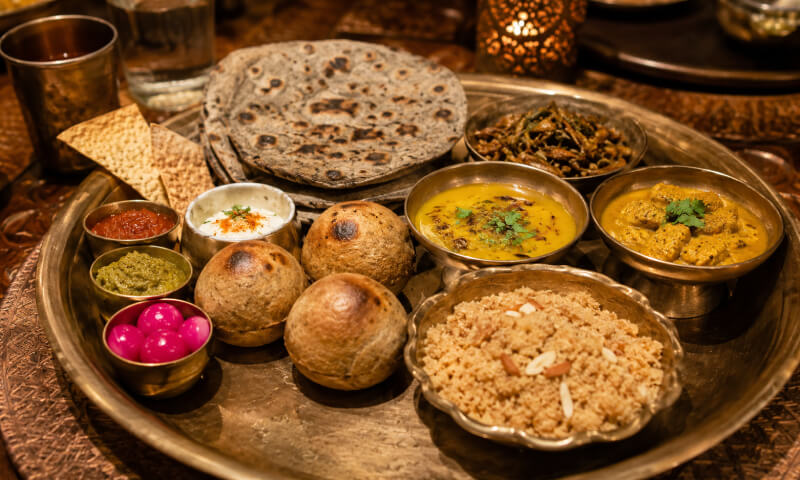
Dal baati churma is the state dish and the one most people name first. Baati are hard wheat dough balls, traditionally baked in embers or hot sand, then cracked open and drenched in ghee. Dal is a spiced lentil curry to dip them in. Churma is the same dough crumbled with jaggery and more ghee, eaten alongside as a sweet. It is enormously heavy. People underestimate this constantly. It’s built for someone doing physical work on one big feed a day.
Gatte ki sabzi is the clever one. Gram flour is kneaded with spices, rolled into logs, boiled, sliced into discs, and simmered in a yoghurt gravy. No vegetables, no meat, and yet it eats like a proper curry with texture in it. If you want to understand Rajasthani cooking in one dish, it’s this rather than the famous one.
Ker sangri is an acquired taste and worth acquiring. Sour, chewy, salty, quite hot. It tastes like the place it comes from.
Laal maas is the meat dish, and it’s the one that has travelled.
Laal maas, explained properly
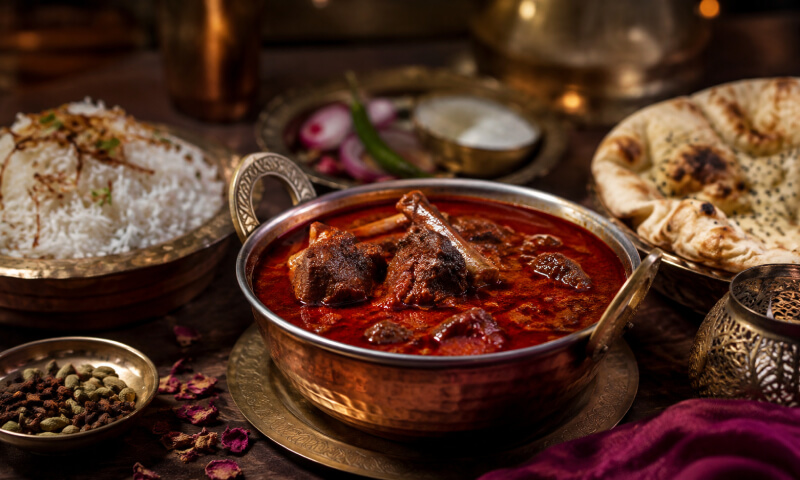
Laal maas means red meat, and in Rajasthan it’s made with mutton, which in Indian usage means goat rather than sheep. The red is chilli, not tomato. There is no tomato in a traditional laal maas at all.
The chillies are the point. Mathania chillies, grown around a village near Jodhpur, are the classic choice. They are deeply red and they carry a smoky, almost sun-dried flavour that ordinary chilli powder doesn’t have. They’re also genuinely hot. Not showy hot. Hot in the way a dish is when nobody was thinking about tourists when they made it. [CONFIRM: whether we source Mathania chillies or use a substitute blend.]
The rest of the dish is short. Whole garlic in quantity, yoghurt, ghee, whole spices, and time. Yoghurt does the tenderising and stops the chilli from being a flat wall of burn. It’s a thin gravy, red and slicked with ghee, and it’s meant to be eaten with bajra roti or plain rice rather than something rich.
The history is a hunting one. Laal maas belongs to the Rajput tradition of cooking game in camp after a shoot, when what you had was meat, dried chillies, garlic and whatever dairy came along. Cooking it hard in chilli and ghee also helped mask the strong flavour of game and keep it edible longer. That’s the story as it’s told in Rajasthan, and it fits the ingredients, though anyone presenting the exact origin as settled is going further than the evidence does.
Here’s the thing worth saying plainly. Laal maas is hot, but it is not a heat challenge. It’s a dish where the chilli is the flavour, not a dare. There’s a real difference between a curry made hot on purpose because that’s what it is, and a curry made hot because a customer asked for it to hurt. We’ve written more about that difference in our guide to Indian curry heat levels.
What’s on our menu, and what isn’t
Being straight about this matters more than making the restaurant sound more Rajasthani than it is.
Laal Maas is on our menu. It sits in the non-veg mains. It’s the dish Jasvinder is happiest to be asked about, and it’s the one on our menu with the most direct line back to where he’s from.
Dal baati churma, gatte ki sabzi and ker sangri are not. They’re festival and home dishes that need ingredients and a kind of eating that a Toowoomba dinner service isn’t built around. Ker and sangri in particular are hard to get in Australia in any quantity worth cooking.
What is on the menu, and does carry Rajasthani habits in it, is the way things are cooked rather than the dish names. Yoghurt doing work that water would do elsewhere. Dried whole spices bloomed in ghee. Dal that’s been given time rather than rushed. Our Yellow Dal Tadka and the Karahi dishes are cooked with those habits, even though they’re not regional Rajasthani dishes by name.
Most of the rest of the menu is North Indian in the broader Punjabi sense, which is true of nearly every Indian restaurant in Australia, and we’ve unpacked why in our post on Punjabi food.
Rajasthani food in a Toowoomba winter
Toowoomba sits about 700 metres up, and anyone who has spent a July here knows the range gets properly cold. That’s when laal maas makes the most sense, and it’s when we sell the most of it.
Desert food gets assumed to be light. It isn’t. Deserts are cold at night, the cooking is built around ghee and long simmering, and a bowl of laal maas with roti on a cold Darling Downs evening does what it was designed to do somewhere else.
Frequently asked questions
What is Rajasthani food known for?
Dried spices, heavy use of ghee, and cooking with yoghurt or buttermilk instead of water. Because fresh vegetables were scarce in the desert, the cuisine leans on lentils, dried beans and gram flour. The dishes it’s best known for are dal baati churma, gatte ki sabzi, ker sangri and laal maas.
Is Rajasthani food very spicy?
Some of it is genuinely hot, particularly laal maas and ker sangri, which use a lot of dried red chilli. But heat isn’t the defining feature. Sourness from yoghurt and buttermilk and richness from ghee matter just as much. Plenty of Rajasthani home cooking is mild and heavy rather than hot.
What is laal maas?
A Rajasthani mutton curry cooked with dried red chillies, whole garlic, yoghurt and ghee. The name means red meat, and the colour comes entirely from chilli rather than tomato. It comes out of a hunting tradition where game was cooked hard in chilli to tenderise it and keep it. It’s on our menu.
Is laal maas hotter than vindaloo?
They’re hot in different ways. Vindaloo gets its bite from chilli plus vinegar, so it’s sharp and acidic. Laal maas is a deeper, smokier heat from dried red chilli with yoghurt behind it. Cooked traditionally, laal maas is the hotter of the two. Cooked to order in an Australian restaurant, either can be dialled up or down.
Is Rajasthani food mostly vegetarian?
A lot of it is. Rajasthan has large Marwari and Jain communities with long vegetarian traditions, and the classic dishes built on gram flour and lentils come from that. The meat cooking is largely a Rajput tradition, which is where laal maas and the game dishes sit. Both are genuinely Rajasthani.
Can I get dal baati churma at Ice n Spice?
No. It’s not on our menu. It needs a specific baking method and it’s really a celebration and home dish rather than a restaurant one. If you want the Rajasthani side of our cooking, the Laal Maas is the dish, and the Yellow Dal Tadka is cooked in the same spirit.
Is Rajasthani food gluten free?
A good deal of it is, since so much is built on lentils, gram flour and rice. But not all. Gatte ki sabzi is gram flour and naturally wheat free, while baati and the roti eaten alongside are wheat. On our menu, all breads contain wheat, and we mark gluten free dishes clearly.
Is your laal maas halal?
Our chicken, lamb and goat come from halal certified suppliers. The venue itself is not halal certified, we serve beef, and we serve alcohol on site. If that distinction matters to you, it’s worth reading our halal page in full rather than taking a one word answer.
What should I order with laal maas?
Something plain. Steamed or jeera rice, or a butter roti. The dish is rich and hot enough that a creamy side fights it rather than helping. If you’re sharing a table and someone wants a gentler dish next to it, a Paneer Butter Masala or a Vegetable Korma balances a laal maas better than another red curry would.
If you’ve eaten a lot of Indian food in Australia and never seen the word Rajasthan on a menu, that’s the gap this dish fills. Order the Laal Maas, ask for it as it’s meant to be, and eat it with plain rice and roti rather than something rich. We’re on Margaret Street, open lunch and dinner seven days, and Jasvinder will happily tell you about it if the pass isn’t on fire.