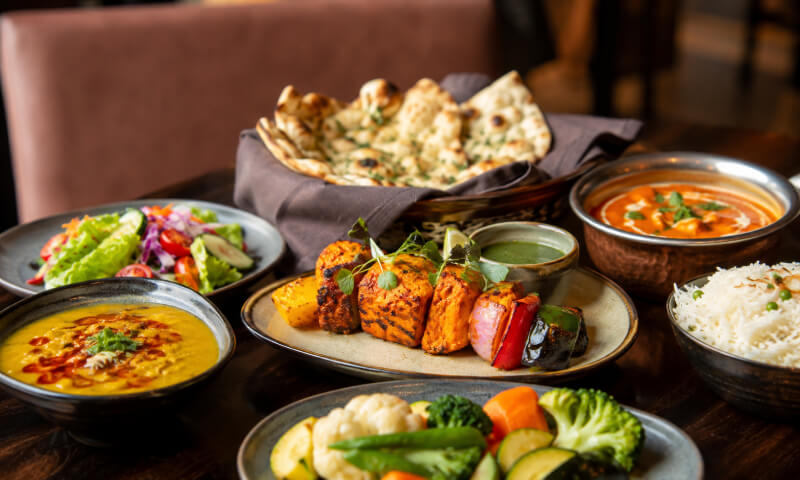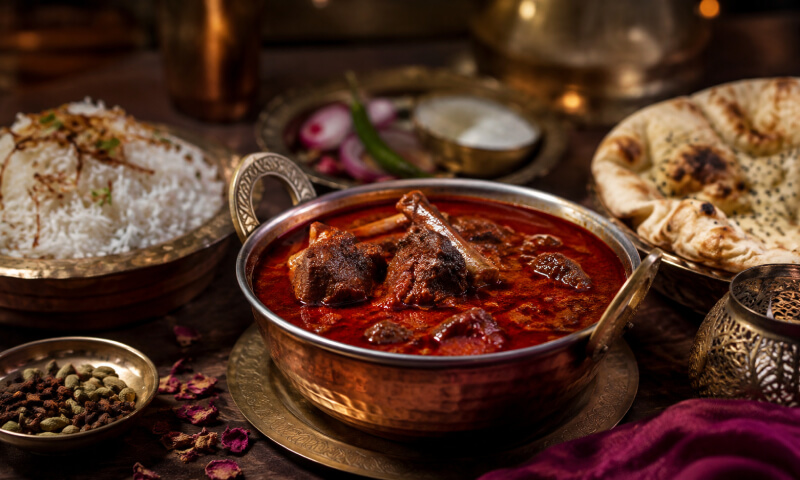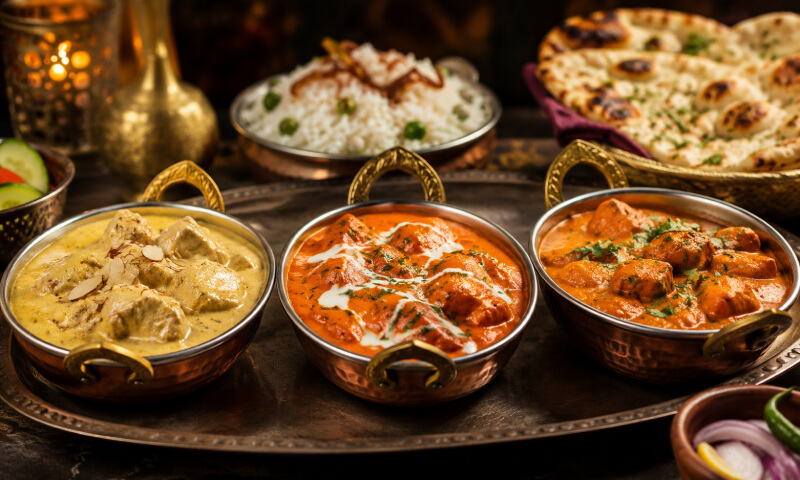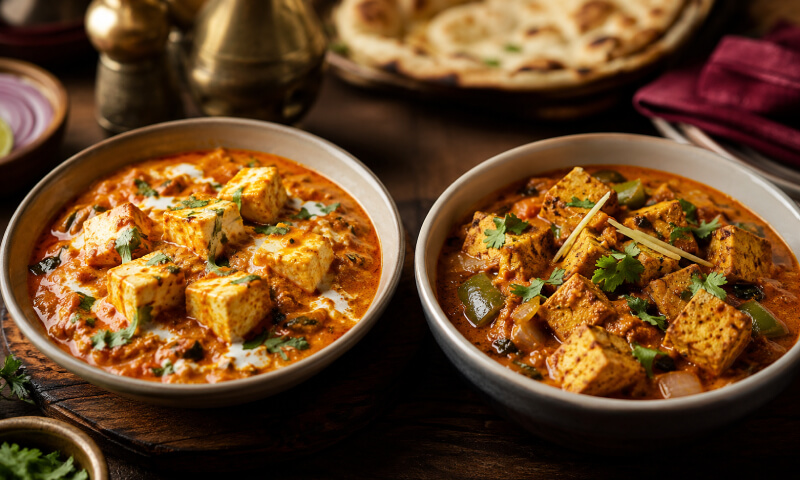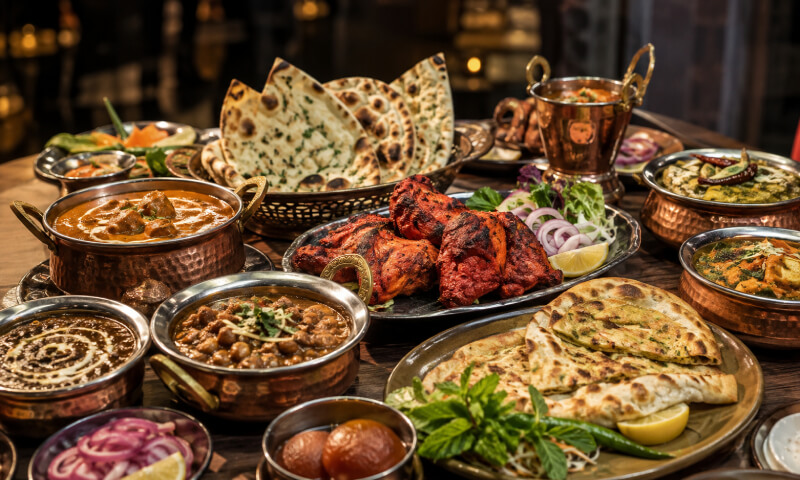
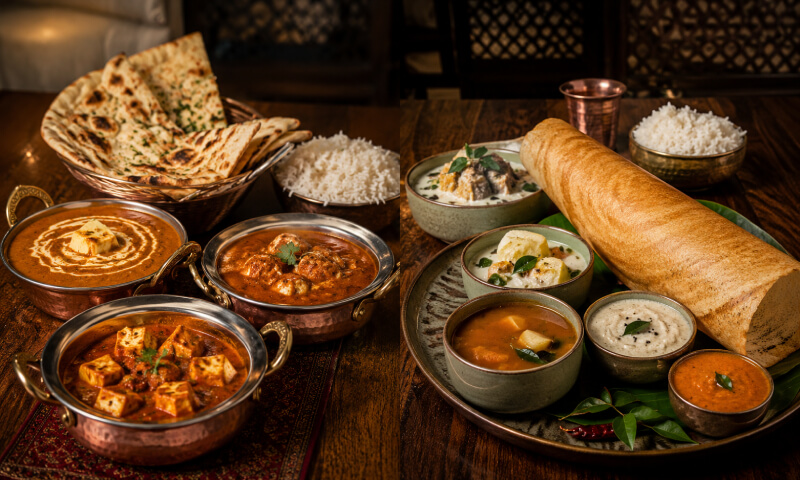
North Indian food is built on wheat, dairy and dried whole spices, with thick gravies and breads cooked in a tandoor. South Indian food is built on rice, coconut and fresh aromatics, with thinner, tangier gravies seasoned with curry leaf, mustard seed and tamarind. The staple grain is the clearest dividing line, and almost every other difference follows from climate.
Start with what grows
The north of India has cold winters and river plains suited to wheat. The south is tropical, wet, and suited to rice and coconut palms. That’s the whole argument in two sentences, and everything else is detail hanging off it.
Wheat means bread. Roti, naan, paratha, kulcha, all of it. Bread is the plate in North India, and the curry is what you pick up with it. Rice means rice, at every meal, in quantity, with the dishes ladled over or beside it.
Coconut grows on the coast and not in Punjab, so coconut is everywhere in southern cooking and nearly absent from northern. Dairy is the reverse. The northern plains have a long cattle and buffalo tradition, which is why butter, cream, ghee, paneer and yoghurt sit at the centre of so many northern dishes.
The fat tells you where you are
If you want a shortcut for placing an Indian dish on a map, look at what it was cooked in.
Ghee and mustard oil are northern. Ghee for richness in the plains and in Rajasthan, mustard oil for the pungent bite you get in Punjabi and Bengali cooking. Coconut oil and sesame oil are southern, particularly Kerala and Tamil Nadu.
That’s not a small distinction. Coconut oil has a flavour of its own, and a Keralan fish curry cooked in sunflower oil tastes like a different dish. Same goes for a Punjabi saag made without ghee. The fat isn’t a cooking medium in Indian food, it’s an ingredient.
Thick and creamy versus thin and tangy
North Indian restaurant gravies are usually built on a base of onion, tomato, ginger and garlic, cooked down hard, often finished with cream, yoghurt or a cashew paste. They cling to bread. Butter chicken is the extreme version of this and it’s popular for obvious reasons.
South Indian gravies are generally looser and sourer. The sourness comes from tamarind or kokum rather than tomato, and the aroma comes from a tempering, called tadka or tarka, where mustard seeds, curry leaves, dried chilli and sometimes urad dal are popped in hot oil and poured over at the end.
That tempering is the sound of a South Indian kitchen. Mustard seeds cracking in oil, then curry leaves going in and spitting. Northern cooking uses tempering too, but it tends to happen at the start of a dish rather than as a finishing flourish.
Whole spices also differ. Cardamom, cinnamon, clove and bay, the garam masala family, lean north and Mughal. Curry leaf, mustard seed, fenugreek, asafoetida and coconut lean south. Chilli is used across the whole country, which is why “south Indian food is hotter” is only sometimes true.
Tandoor bread versus fermented batter
The two most recognisable cooking methods in Indian food sit at opposite ends of the country.
The tandoor is a clay oven that runs extremely hot, and it’s the northern one. Naan is slapped onto the inside wall, meat goes in on skewers, and the whole thing is a high-heat, fast, dry method. We’ve written a full explanation of how a tandoor works if you want the mechanics.
The southern equivalent isn’t an oven at all, it’s fermentation. Rice and urad dal are soaked, ground into a batter, and left overnight to sour and rise. That batter becomes dosa when it’s spread thin on a griddle, idli when it’s steamed into soft cakes, and uttapam when it’s poured thick. Add vada, a fried lentil doughnut, and sambar and coconut chutney to go with all of them.
You cannot make a dosa in a tandoor and you cannot make a naan on a dosa griddle. The equipment tells you the cuisine.
How a meal is put together
A northern meal is usually bread plus a couple of dishes, with rice as a side rather than the centre. Everything arrives at once and you tear, dip and share. That format suits a restaurant, which matters more than it sounds.
A traditional South Indian meal is often served in stages on a banana leaf or a thali, with rice as the constant and a sequence of things going over it. Sambar first, then rasam, then curd rice to finish. There’s an order to it. Restaurants outside India rarely reproduce that, so most people’s experience of South Indian food is a dosa at a specialist place rather than a full meal.
Why Australian Indian menus are mostly northern
Here’s the honest part. Our menu is predominantly North Indian, and so is nearly every Indian restaurant menu in Australia. That’s not an accident and it’s not laziness.
Two reasons. The first is migration. A large share of Indian migration to Australia, the UK and Canada came from Punjab and the wider north, and people cook what they know. The restaurant trade that grew out of that migration was staffed and owned by northern families, ours included, and the menu followed.
The second is that the northern format travels better commercially. Thick gravies hold, reheat and portion well. A tandoor is one piece of equipment that produces bread, entrees and grilled meats all night. Dosa, by contrast, needs batter fermented ahead, a dedicated griddle, and a cook standing at it making them one at a time to order. That’s a different business, which is why dedicated South Indian restaurants exist as their own category.
Add to that the British curry house lineage, which shaped what Australian diners expected an Indian menu to look like before most of us had eaten in India, and you get the standard menu you see everywhere.
The result is that a lot of Australians have eaten Indian food for twenty years without ever really eating South Indian food. It’s worth knowing that’s what happened.
The southern and coastal dishes we do cook
We’re not going to overclaim here, because the fastest way to lose trust is to call a Punjabi kitchen a pan-Indian one.
Goan Fish Curry is the closest thing on our menu to coastal cooking. Goa is on the west coast, not the south proper, but the dish shares the southern grammar: coconut, tamarind, a thinner gravy, seafood rather than lamb. There’s a lot more to say about Goa, so we’ve given it its own post.
The madras dishes, Prawn Madras, Goat Madras and Beef Madras, carry the old name for Chennai. Worth being straight about this: madras as a menu item is largely a British and Australian restaurant invention rather than a dish you’d order in Tamil Nadu. What it does borrow honestly is the southern habit of dried red chilli and a sharper, thinner, more sour gravy than a northern curry.
Coconut rice is on the rice list, and coconut with rice is about as southern as a pairing gets.
Everything else, the butter chicken, the rogan josh, the naan, the dal makhani, sits firmly in the north. Our Laal Maas is Rajasthani, which is north-west and its own thing again, and that one is worth ordering precisely because it doesn’t sound like the rest of the menu.
What Toowoomba orders
Butter chicken outsells everything, which will surprise nobody. The pattern we notice is that people who order Prawn Madras or Goan Fish Curry tend to order them again, and they’re often people who’ve travelled or grown up eating coastal food. If you’ve had the same creamy northern curry every visit, the fish curry is the one that will feel least familiar and most worth it.
Frequently asked questions
What is the main difference between North and South Indian food?
The staple grain. North India eats wheat, so bread is at the centre of the meal. South India eats rice at nearly every meal. From there follow the other differences: ghee and dairy in the north against coconut and coconut oil in the south, and thicker gravies in the north against thinner, more sour ones in the south.
Is South Indian food spicier than North Indian?
Sometimes, but it’s not a rule. Andhra cooking is genuinely very hot, while much of Kerala is aromatic rather than fiery. In the north, Rajasthani laal maas and Punjabi karahi dishes can be seriously hot. The bigger difference is the type of heat: sharper and more sour in the south, deeper and rounder in the north.
Is butter chicken North or South Indian?
North Indian, and more specifically Punjabi. It’s built on tomato, butter and cream, cooked with tandoori chicken, all of which are northern. There’s no coconut, no tamarind and no curry leaf in it. We’ve written a full post on what butter chicken actually is if you want the detail.
Are dosa and idli available at Ice n Spice?
No. Both need a rice and lentil batter fermented overnight and a dedicated griddle or steamer, which is a different kitchen setup to ours. Our menu is North Indian with some coastal dishes, and we’d rather cook that properly than do a half version of something else.
What South Indian style dishes are on your menu?
Goan Fish Curry is the closest, using coconut and tamarind in a thinner gravy. The madras dishes, Prawn Madras, Goat Madras and Beef Madras, use dried red chilli and a sharper gravy in that direction, though madras as a menu name is a restaurant invention rather than a Tamil dish. Coconut rice is on the rice list.
Why do Australian Indian restaurants all serve similar food?
Because most of them descend from the same migration and the same restaurant model. Punjabi and wider northern families brought the food, the tandoor suits a restaurant kitchen better than a dosa griddle does, and the British curry house set expectations for what an Indian menu looks like before most Australians had eaten in India.
Is North or South Indian food better for vegetarians?
Both are excellent, in different ways. South Indian food has a deeper everyday vegetarian tradition, with sambar, rasam and dosa all naturally meat free. Northern vegetarian cooking leans on paneer, lentils and dairy. Our vegetarian section runs to thirteen dishes, and several are vegan as cooked.
Which is better for gluten free eating?
South Indian, in principle, because rice replaces wheat almost entirely. On a northern menu like ours you need to skip the breads, since all of them contain wheat, and build the meal on rice and curries instead. We mark gluten free dishes on the menu and there’s a page explaining how we handle it.
If your Indian ordering has been northern by default, the Goan Fish Curry is the easiest way to taste the other half of the country without leaving Margaret Street. Order it with steamed or coconut rice and skip the naan for once. We’re open lunch and dinner seven days.