Kashmiri food is the cooking of the Himalayan valley in India’s far north, with strong Persian influence, a formal feast tradition called wazwan, and a fondness for fennel, dried ginger and saffron. Rogan josh is its most famous export. In the original, the deep red colour comes from Kashmiri chilli and sometimes ratanjot root, not from tomato, and the gravy is built on yoghurt.
A valley that cooks like Persia
Kashmir sits high, cold and enclosed by mountains, and its food reflects trade routes rather than the Indian plains below it.
Persian and Central Asian influence runs right through it. Craftsmen and Sufi teachers came from Persia and Samarkand centuries before the Mughals arrived, and the Mughal court then made Kashmir its summer retreat and brought its own kitchen with it. What came out the other side is Indian food that leans on dried fruit, nuts, saffron, fennel and yoghurt rather than on the tomato and onion base you’d find in Punjab.
The climate did the rest. Long winters mean preserving. Kashmiri households dry vegetables through summer to eat in the snow months, and the meat cooking is rich in a way that makes sense at altitude. Morel mushrooms, walnuts, lotus root and collard greens all turn up because they grow there.
Saffron does too. The fields around Pampore produce some of the world’s best, harvested from crocus flowers in autumn, which is a detail Toowoomba people tend to enjoy. The Garden City’s most expensive spice connection is a flower.
Wazwan, the feast that runs to 36 courses
If there’s one thing to know about Kashmiri food beyond rogan josh, it’s wazwan.
Wazwan is a ceremonial multi-course meal, mostly mutton, cooked by a waza, a master chef, working with a team through the night. It runs at weddings and major occasions and can stretch to dozens of courses. Guests eat four to a trami, a large copper platter, sharing as it’s refilled.
The dishes have their own logic. Rista is a meatball in a red gravy. Tabak maaz is lamb rib, simmered then fried until the edges crisp. Yakhni is a pale yoghurt gravy scented with fennel. Gushtaba, a large pounded mutton ball in a yoghurt gravy, is served last and is treated as the dish that judges the cook.
Rogan josh sits inside that repertoire. It was never a standalone restaurant curry. It was one course among many, made by specialists.
Two Kashmiri kitchens, not one
This is the part that gets flattened in most write-ups, and it’s the most interesting thing about the cuisine.
Kashmiri Muslim cooking, the wazwan tradition, uses onion, shallots and garlic freely, along with lamb fat and mustard oil.
Kashmiri Pandit cooking, the Hindu Brahmin tradition of the valley, avoids onion and garlic entirely. In their place it uses asafoetida, ground fennel and dried ginger powder as the aromatic base, with yoghurt for body. That combination is the flavour most people can’t place when they eat properly made Kashmiri food. Fennel and dried ginger where you expect fried onion.
So there are two authentic rogan josh recipes and they differ on the most basic question in Indian cooking, which is whether you start with onions. Anyone who tells you there’s one true version hasn’t looked hard enough.
Where the name comes from
Rogan josh is Persian, and the translation is contested. Two readings are commonly given and both are defensible.
The first takes roghan as oil or clarified fat and josh as heat or intensity, giving something like “cooked in fat at high heat”. That fits the method, which involves cooking meat in a lot of fat until the oil separates and rises red on the surface.
The second takes roghan in the sense of red, giving “red heat” or “red passion”, which fits the appearance.
We don’t think you need to pick. Both readings describe a real feature of the dish, and the honest position is that the etymology isn’t settled.
Why it’s red, and why it isn’t tomato
Here’s the thing most people get wrong. A traditional rogan josh contains no tomato.
The red comes from two places. First, Kashmiri chilli, a variety prized for deep colour and comparatively mild heat. Cooks use it in quantity precisely because they can. You get a strong red without making the dish painful, which is the opposite of how chilli usually works.
Second, ratanjot, the dried root of alkanet, steeped in hot oil to release a red dye. It contributes colour and a faint earthiness and very little else. Some cooks use dried cockscomb flower, called mawal, for the same purpose.
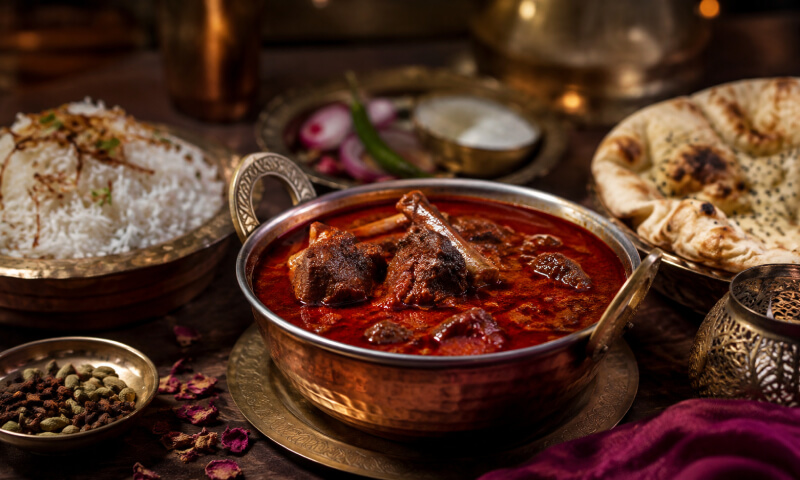
The gravy underneath all that is yoghurt, whisked in gradually so it doesn’t split, plus fennel, dried ginger, and whole spices like clove, cardamom and cinnamon. The finish is a thin layer of red oil sitting on top. That oil slick is the sign the dish is done properly, not a sign that something’s gone wrong.
What happened to rogan josh in restaurants
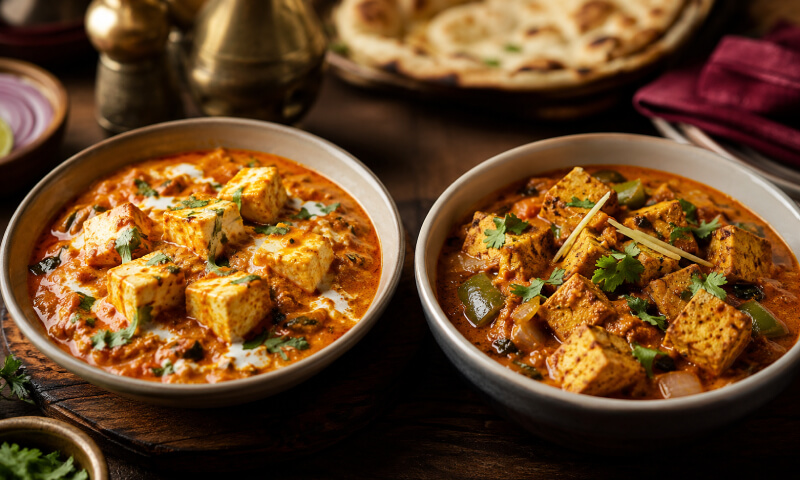
Somewhere between Kashmir and a suburban Australian menu, rogan josh became a medium lamb curry in a brown-red tomato and onion gravy, and often a fairly sweet one.
You can see how it happened. Kashmiri chilli and ratanjot are hard to source and expensive. Tomato paste is not, and it delivers colour, acidity and body in one move. Yoghurt is fussy and splits if you rush it. Onions are cheap and forgiving. Multiply those decisions across thousands of kitchens over fifty years and the dish drifts.
We’ll be honest about our own position. Our Lamb Rogan Josh is a restaurant rogan josh cooked in a North Indian kitchen, not a wazwan course. What we do hold onto is the whole-spice base, yoghurt in the gravy, and fennel and dried ginger doing real work in the spice mix rather than being crowded out. [CONFIRM: whether we use Kashmiri chilli specifically, and whether ratanjot is used.]
If you order it expecting a hot curry you’ll be surprised, because rogan josh isn’t a hot dish. It’s aromatic and deep. That’s the honest description, and it’s why it works as a next step for people who’ve had butter chicken forty times and want something with more spice character but not more burn.
What Toowoomba orders it with
Rogan josh is the dish we most often see ordered by someone at a table where everyone else has gone creamy. It sits well beside butter chicken without repeating it, since one is sweet and mild and the other is spiced and savoury.
Order it with saffron rice if you want the Kashmiri side of the plate, since saffron is as Kashmiri as an ingredient gets, and our guide to Indian rice dishes explains what separates the rice options. Garlic naan works too, though a plain butter roti lets the spices come through better.
For a comparison at the other end of the north, our Laal Maas from Rajasthan is also a red lamb-family curry with no tomato in it, and it’s a useful thing to taste next to a rogan josh. One is red and gentle, the other is red and serious.
Frequently asked questions
What is Kashmiri food?
The cooking of the Kashmir valley in India’s far north, heavily influenced by Persia and Central Asia. It leans on yoghurt, fennel, dried ginger, saffron, dried fruit and nuts, with mutton at the centre of most feast dishes. Its best known tradition is wazwan, a formal multi-course meal, and its best known dish is rogan josh.
Is rogan josh spicy?
Not particularly. It’s aromatic rather than hot. The Kashmiri chilli that gives the dish its red colour is chosen for colour rather than heat, so a traditional rogan josh can look fierce and eat gently. We cook ours mild, medium or hot on request, but medium is where the spices show best.
What makes rogan josh red?
Kashmiri chilli, which is a deep red variety with mild heat, and often ratanjot, a dried root steeped in hot oil to release a red colour. Some cooks use dried cockscomb flower instead. Tomato is not part of the traditional dish, even though most restaurant versions rely on it.
What does rogan josh mean?
It’s Persian, and there are two readings. One takes roghan as oil or clarified fat and josh as intense heat, giving “cooked in fat at high heat”. The other takes roghan as red, giving “red heat”. Both fit the dish and the etymology isn’t settled, so we present both rather than choosing.
Is rogan josh Kashmiri or Mughlai?
Kashmiri, but with Persian and Mughal ancestry, which is exactly why the two get confused. The dish belongs to the Kashmiri wazwan repertoire, and its technique and spicing came into the valley along Persian and Central Asian routes. Both answers contain truth, which is normal for food that old.
Why does Kashmiri Pandit food have no onion or garlic?
It follows a Brahmin dietary tradition that avoids both. Instead the base is asafoetida, ground fennel and dried ginger powder, with yoghurt for body. It produces a genuinely different flavour, sweeter and more perfumed than an onion-based gravy, and it’s one of the most distinctive vegetarian-adjacent traditions in India.
Is your rogan josh made the traditional Kashmiri way?
Not exactly, and we’d rather say so. Ours is a restaurant rogan josh cooked in a North Indian kitchen. We keep the yoghurt, the whole spices, and fennel and dried ginger in the mix rather than burying them under tomato, but a true wazwan rogan josh is made by specialists as one course of many.
What should I order with rogan josh?
Saffron rice suits it, since saffron is Kashmir’s own spice. Butter roti is better than a rich naan if you want the spicing to come through. It also shares a table well with a mild creamy dish like Paneer Butter Masala, because it’s savoury and spiced rather than sweet.
Is rogan josh gluten free?
The curry is, and we mark gluten free dishes on the menu. All our breads contain wheat, so order it with rice rather than naan. If you’re eating gluten free with a group, rogan josh with saffron or jeera rice is one of the easiest orders on the menu.
If you’ve settled into ordering the same thing every visit, Lamb Rogan Josh with saffron rice is a good way out of the rut without jumping straight to something hot. Ask for medium. We’re on Margaret Street, lunch and dinner seven days.