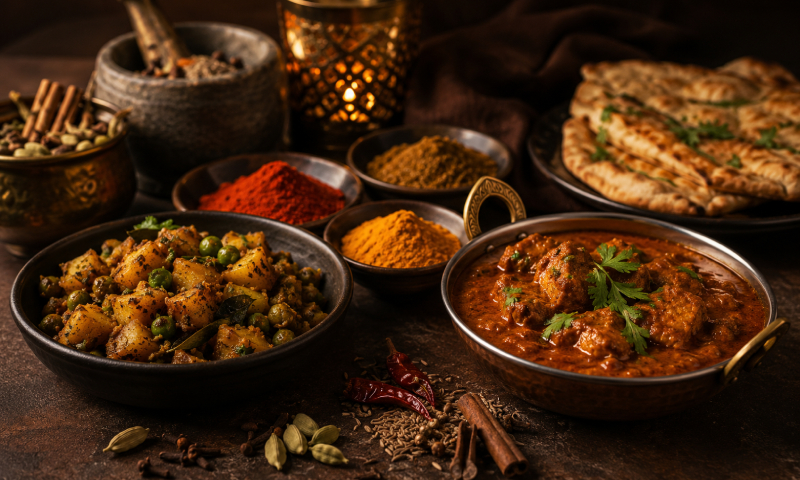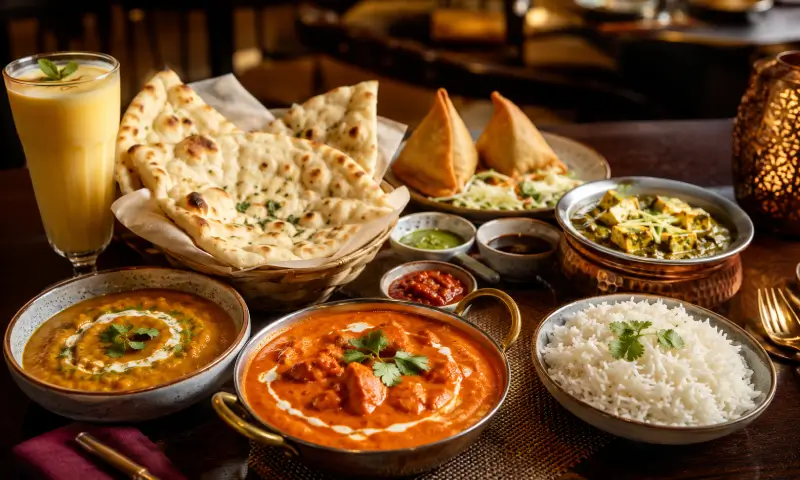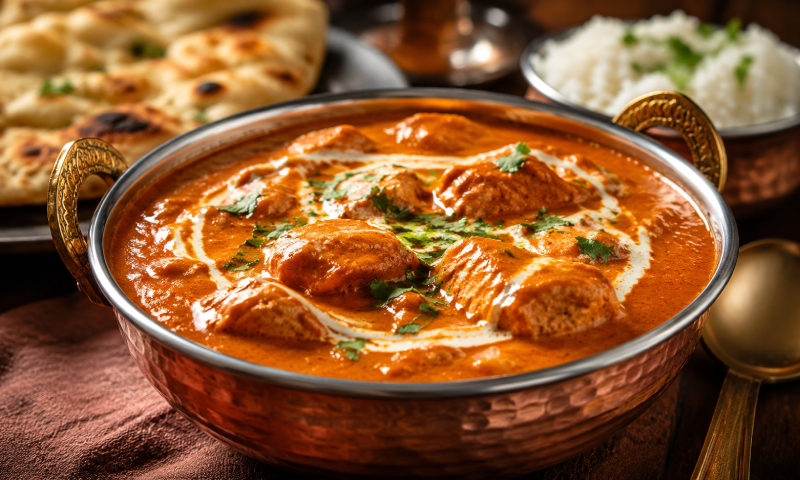
Butter chicken, or murgh makhani, is a north Indian dish of chicken marinated in yoghurt and spices, cooked in a tandoor, then finished in a gravy of cooked-down tomato, butter and cream with dried fenugreek leaves. It’s mild, slightly sweet and very rich. It’s the most ordered Indian dish in Australia and the one most often cooked badly.
The two-stage dish
The single most useful thing to understand about butter chicken is that it’s made in two separate parts that only meet at the end.
Part one is the chicken. Boneless thigh or breast is marinated in yoghurt with ginger, garlic, lemon, salt and ground spices, overnight in any kitchen that takes it seriously. The yoghurt does real work, its acid and enzymes loosen the protein so the meat stays soft and the flavour travels past the surface. The chicken then goes onto skewers into the tandoor, a clay oven that runs far hotter than a home oven, until the outside chars and the inside is still juicy.
Part two is the makhani gravy. Tomatoes are cooked down slowly with aromatics until they lose their raw sharpness and turn sweet. The mixture gets blended smooth and strained. Then butter goes in, then cream, then the seasoning is corrected. Right at the end, kasoori methi (dried fenugreek leaves) is crushed between the palms over the pot.
The tandoori chicken is added to the finished gravy shortly before service. It is not simmered in it for an hour. That’s the whole trick, and it’s the main reason restaurant butter chicken tastes different to the one you make at home. We’ve gone through that properly in why your homemade butter chicken doesn’t taste like the restaurant’s.
What kasoori methi does
Most people who love butter chicken have never heard of the ingredient that makes it recognisable.
Kasoori methi is dried fenugreek leaves. Crushed and added at the end, it gives a savoury, slightly bitter, faintly maple-like note that cuts through the butter and cream. It’s the smell that hits you when a plate of good butter chicken lands on the table. Leave it out and the dish goes dull and one-note sweet. A lot of the disappointing butter chicken sold in this country is missing it, or had it added too early and cooked out.
Where it came from
The story most often told puts butter chicken at Moti Mahal in Delhi, some time around the 1940s or 50s, after the family behind it moved from Peshawar during Partition. The account goes that leftover tandoori chicken was drying out, so the kitchen made a tomato and butter gravy to revive it. The dish stuck, and the same restaurant is also credited with dal makhani, which uses a similar butter-and-cream logic on black lentils.
That origin is widely repeated and it’s the version the family has defended publicly for decades. It’s also contested. There have been legal disputes over who can claim the invention, and food historians point out that tomato and cream gravies were not unknown before then. Treat it as the best-known story rather than settled fact.
What’s not in dispute is the technique behind it. The tandoor tradition, the yoghurt marinade and the use of dairy to soften a spiced gravy are all north Indian, and specifically Punjabi. That part of the dish’s history is solid.
Why it became Australia’s default order
Butter chicken is the first Indian dish most Australians eat, and for a lot of people it’s the only one.
There are real reasons for that. It’s mild, and Australian palates in the 1980s and 90s weren’t used to chilli. It’s creamy and sweet, which lines up with flavours people already knew. It works with rice, it works with naan, and it survives a fifteen minute drive home better than a dry dish does. Once it’s on every menu, it becomes the safe order at an unfamiliar restaurant, which keeps it on every menu.
In Toowoomba specifically, it does most of its work at lunch and in winter. When it’s five degrees on the range in July, a rich curry with bread is exactly what people want. Our lunch thali gets ordered with butter chicken as one of the two dishes more often than anything else.
None of this makes it the best dish on an Indian menu. It makes it the most familiar one.
The honest problem with butter chicken
Here’s the part most restaurants won’t put on their own blog.
Because butter chicken sells in volume, a lot of kitchens make it from a shared base gravy. One large pot of onion, tomato and cream is cooked in the morning, then ladled out and adjusted with different spices to become butter chicken, tikka masala, korma and half the rest of the menu. It’s efficient. It’s also why so many curries at so many restaurants taste like variations on the same thing.
Add to that the tendency to over-sweeten. Sugar, honey and sometimes cashew paste get pushed further and further to suit the market, until the dish reads as a sweet tomato cream sauce with chicken in it. At that point the fenugreek is gone, the tandoor char is gone, and what you’re eating has very little to do with murgh makhani.
You can usually tell. Good butter chicken has a smoky note from the tandoor, a savoury backbone under the sweetness, and chicken with slightly charred edges rather than uniformly pale cubes. If every piece looks identical and boiled, it was cooked in the sauce.
We cook ours the long way because Jasvinder won’t do it another way, and because if you’re going to serve the most common dish in the country you should serve it properly.
What to eat with it
Plain butter naan or butter roti. Butter chicken has enough going on that garlic or cheese naan starts to compete with it, though plenty of people order garlic naan anyway and we’re not going to argue. Steamed rice is fine, jeera rice is better, because the cumin gives the plate something savoury to push against.
If you’re ordering for a table, pair it with something that isn’t creamy. Aloo Gobi, Channa Masala or a Vegetable Jalfrezi gives everyone a break from the richness. Two cream-based curries side by side is the most common ordering mistake we see, and by halfway through people stop tasting either of them.
Butter chicken and the rest of the menu
If butter chicken is your entry point, there are a few obvious next steps.
Chicken Tikka Masala is the closest relative, tangier and slightly hotter. We think it’s the better dish and we’ve explained why in butter chicken vs tikka masala.
Paneer Butter Masala is the vegetarian version of the same idea, with paneer in place of chicken in a similar tomato and cream gravy.
Butter Prawns and Fish Butter Masala apply the same gravy logic to seafood, and both are underordered. Dal Makhani comes out of the same tradition and, if the Moti Mahal story is right, the same kitchen.
Frequently asked questions
What does butter chicken taste like?
Mild, rich and slightly sweet, with a smooth tomato and cream sauce. There’s a savoury, faintly bitter note from dried fenugreek that stops it being cloying, and a light smokiness from the tandoor-cooked chicken. It’s warm with spice rather than hot with chilli. If it tastes only of sweet tomato, it’s been made badly.
Is butter chicken actually Indian?
Yes. Unlike tikka masala, whose origin is genuinely contested between Glasgow and India, butter chicken is understood to have come from Delhi, most often credited to Moti Mahal around the 1940s or 50s. The exact claim has been disputed in court, but its north Indian origin isn’t in question.
What is butter chicken sauce made of?
Tomatoes cooked down and blended smooth, butter, cream, ginger and garlic, ground spices including cumin, coriander and garam masala, a little Kashmiri chilli for colour, and kasoori methi crushed in at the end. Many kitchens add cashew or almond paste for body, and some add sugar or honey.
Is butter chicken spicy?
No, it’s the mildest curry on most menus. It’s heavily spiced but contains almost no chilli, and the cream and butter soften what little there is. We’ve answered this in detail in is butter chicken spicy.
Is butter chicken gluten free?
As we cook it, yes. The curry itself contains no wheat. Every naan and roti on our menu does contain wheat, so order rice with it instead. Tell your waiter when you order so the kitchen can handle it properly. We’ve been voted number one for gluten free in Toowoomba by local diners.
Is butter chicken healthy?
Not especially, and we’d rather be honest about it. It’s built on butter and cream. A serve with rice and naan is a substantial meal. If you want something lighter from the same menu, a tandoori dish like Chicken Tikka or Lamb Seekh Kebab has no gravy at all, and Vegetable Jalfrezi is tomato-based without the cream.
Is butter chicken halal?
Our chicken comes from halal-certified suppliers, as does our lamb and goat. The venue itself isn’t halal certified, we serve beef, and we’re a licensed bar with alcohol on site. That’s the full picture rather than a simple yes.
What’s the difference between butter chicken and korma?
Korma is thickened with cashew or almond paste and cream and has no tomato, so it’s nutty and pale rather than red and tangy. Butter chicken is tomato-led. Both are mild. Korma is arguably the milder of the two because it carries no acidity at all.
Can butter chicken be made without cream?
It can be made with less, and some kitchens use cashew paste and yoghurt to reduce it, but at that point you’re cooking a different dish. Cream is structural in makhani gravy, not a garnish. We won’t make a low-fat version because it wouldn’t be butter chicken.
Butter chicken sits in the non-veg mains on our menu, alongside the tikka masala it gets confused with. If you’ve been ordering it for years without ever comparing it to anything else, order it next to a Karahi Chicken or a Rogan Josh and see what you think. That’s usually how people find their actual favourite.